Systems Failure at RBS – Again
Subhead: Modernization is NOT Optional!
Once again customers of The Royal Bank of Scotland (RBS) and its subsidiaries Ulster, Natwest etc are in trouble! Unable to use their debit cards, or access their funds! And the new Chief Executive Ross McEwan admitted today that RBS has failed to invest properly in its systems for decades! RBS has given no explanation of the crash, except that it was not related to the high volumes of transactions on Cyber Monday.
Actually the root problem for RBS, and many other banks and other very large organizations, is NOT that they haven’t invested in their systems for decades. The problem is that they have allowed the systems to evolve without good architecture and governance. Banking systems in particular used to be leading edge. But over the years the core systems that actually run the bank, have become badly out of date. Instead of modernizing the core systems, many banks have responded to demand for new products and services by surrounding the old legacy systems with new bolt on systems. As a result the old systems are held together with sticky tape and sealing wax, and modified piecemeal to adjust to new requirements, and the new systems create more and more interfaces and dependencies (including duplicated, hard coded business rules), so that eventually the systems resemble a hair ball. And as you know, a hairball is a tightly packed cylinder of fur, which also includes all manner of foreign particles, which can be quite hazardous in humans and animals. In systems terms we would more usually refer to the resulting mess as a monolithic systems portfolio.
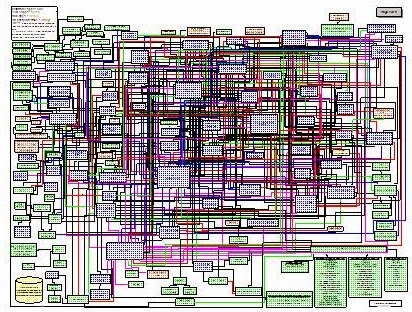
The root problem therefore is twofold:
1. The increasing complexity and risk inherent in making change.
2. Increasing horizon of any change.
And the issues become apparent either when extremely complex operational processes execute incorrectly, or when changes in process, software or environment are made, often unavoidably without full knowledge of all the implications due to lack of experience, documentation or even code!
Although I have no doubt that in all the large banks there are fierce debates about the IT budget, strangely the solution to this problem isn’t about the amount of money that needs to be spent. Rather it’s about how the organization embraces a real modernization program, which is led by good architecture and managed with strong governance.
Sadly in the IT industry the term modernization has come to mean something quite specific – the re-platforming or technology upgrade of some application. Whereas modernization should really encompass a much broader remit including:
1. Establishing a lingua franca between business and IT so that modernization issues and implications are genuinely understood by both business and IT management.
2. Defining a business systems architecture that a) facilitates transformation with low risk and b) progressively develops an inherently agile architecture, that can evolve continuously.
3. A roadmap for progressively rationalizing the business systems portfolio to comply with the architecture.
4. Implementing an integrated business and IT organization that owns the business systems.
5. Implementing knowledge management around business systems that ensures integrity and consistency and ownership of processes, information and rules.
6. Implementing a continuous Agile modernization and ongoing evolution process in both business and IT.
7. Establishing coordination, governance and risk management that ensures architectural integrity at all stages of the life cycle.
It would be easy for business management to think that the sort of problems experienced by RBS and other banks as IT problems. The above list suggests this is nonsense. The only way to properly resolve the issues is for business management to accept co-responsibility for IT. And it’s no accident that the first point in the list above is to ensure that business management understand the issues they are dealing with, and can communicate effectively with the IT organization. This isn’t just attending an education class; it’s embracing a common language that allows critical decisions to be taken on a properly balanced understanding of business and IT assumptions, costs and risks.
Retailers, manufacturers, power companies, logistics companies, government departments etc etc should not be complacent or smug when they see the problems at the banks. In fact almost all very large organizations have these problems. And the message for all enterprises is Modernization is not Optional!
Links:
RBS Crash – Management Prefer Offshoring to Modernization?
CBDI Journal Reports on Modernization

.jpg) December 5th is International Day of the Ninja. Sure, you can dress in black and carry around a set of nunchucks to play the part, but, we all know that’s just subterfuge. And, Halloween was a month ago. Instead, turn yourself into a decision-making ninja, a la Enterprise Portfolio Management (c’mon, you’re reading the Troux blog, you knew that was coming, right?).
December 5th is International Day of the Ninja. Sure, you can dress in black and carry around a set of nunchucks to play the part, but, we all know that’s just subterfuge. And, Halloween was a month ago. Instead, turn yourself into a decision-making ninja, a la Enterprise Portfolio Management (c’mon, you’re reading the Troux blog, you knew that was coming, right?).