An integrated view of change

It often happens that when you reach for the business strategic view to explain why certain things should happen at other levels, communication get overtly complicated. Most of us are used to encountering strategy maps, scorecards, motivation models and since 2009 business model canvases. The problem I’ve encountered is that these perspectives of the business […]

How Strategic Planning relates to Enterprise Architecture?

TOGAF often refers to Strategic Planning without specifying the details of what it consists of. This document explains why there is a perfect fit between the two.

Strategic Planning means different things to different people. The one constant is its reference to Business Planning which usually occurs annually in most companies. One of the activities of this exercise is the consideration of the portfolio of projects for the following financial year, also referred to as Project Portfolio Management (PPM). This activity may also be triggered when a company modifies its strategy or the priority of its current developments.

Drivers for Strategic Planning may be

· New products or services

· A need for greater Business flexibility and agility

· Merger & Acquisition

· Company’s reorganization

· Consolidation of manufacturing plants, lines of business, partners, information systems

· Cost reduction

· Risk mitigation

· Business Process Management initiatives

· Business Process Outsourcing

· Facilities outsourcing or in sourcing

· Off shoring

Strategic Planning as a process may include activities such as:

1. The definition of the mission and objectives of the enterprise

Most companies have a mission statement depicting the business vision, the purpose and value of the company and the visionary goals to address future opportunities. With that business vision, the board of the company defines the strategic (e.g. reputation, market share) and financial objectives (e.g. earnings growth, sales targets).

2. Environmental analysis

The environmental analysis may include the following activities:

· Internal analysis of the enterprise

· Analysis of the enterprise’s industry

· A PEST Analysis (Political, Economic, Social, and Technological factors). It is very important that an organization considers its environment before beginning the marketing process. In fact, environmental analysis should be continuous and feed all aspects of planning, identify the strengths and weaknesses, the opportunities and threats (SWOT).

3. Strategy definition

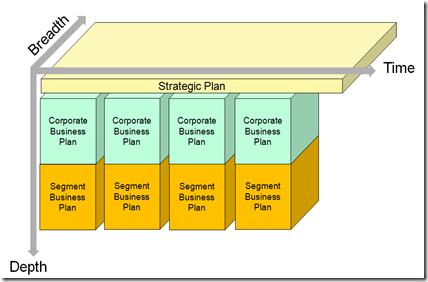
Based on the previous activities, the enterprise matches strengths to opportunities and addressing its weaknesses and external threats and elaborate a strategic plan. This plan may then be refined at different levels in the enterprise. Below is a diagram explaining the various levels of plans.
image

To build that strategy, an Enterprise Strategy Model may be used to represent the Enterprise situation accurately and realistically for both past and future views. This can be based on Business Motivation Modeling (BMM) which allows developing, communicating and managing a Strategic Plan. Another possibility is the use of Business Model Canvas which allows the company to develop and sketch out new or existing business models. (Refer to the work from Alexander Osterwalder http://alexosterwalder.com/).

The model’s analyses should consider important strategic variables such as customers demand expectations, pricing and elasticity, competitor behavior, emissions regulations, future input, and labor costs.

These variables are then mapped to the main important business processes (capacity, business capabilities, constraints), and economic performance to determine the best decision for each scenario. The strategic model can be based on business processes such as customer, operation or background processes. Scenarios can then are segmented and analyzed by customer, product portfolio, network redesign, long term recruiting and capacity, mergers and acquisitions to describe Segment Business Plans.

4. Strategy Implementation

The selected strategy is implemented by means of programs, projects, budgets, processes and procedures. The way in which the strategy is implemented can have a significant impact on whether it will be successful, and this is where Enterprise Architecture may have a significant role to play. Often, the people formulating the strategy are different from those implementing it. The way the strategy is communicated is a key element of the success and should be clearly explained to the different layers of management including the Enterprise Architecture team.

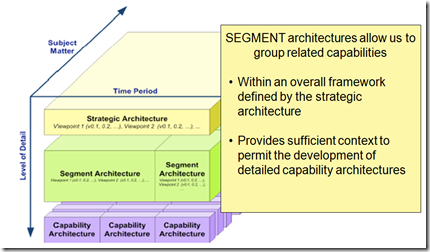
To support that strategy, different levels or architecture can be considered such as strategic, segment or capability architectures.
image

Figure 20-1: Summary Classification Model for Architecture Landscapes

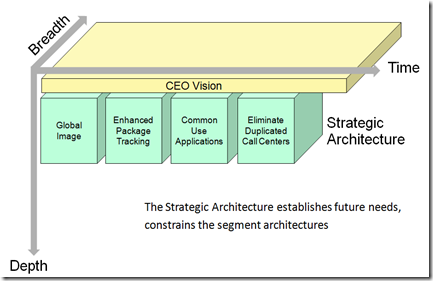
This diagram below illustrates different examples of new business capabilities linked to a Strategic Architecture.
image

It also illustrates how Strategic Architecture supports the enterprise’s vision and the strategic plan communicated to an Enterprise Architecture team.

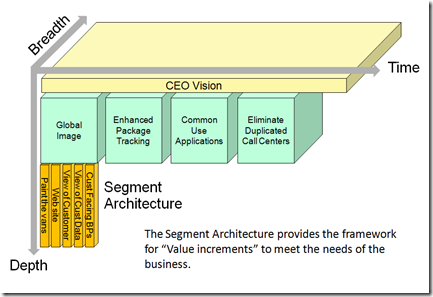
Going to the next level allows better detail the various deliverables and the associated new business capabilities. The segment architecture maps perfectly to the Segment Business Plan.
image

5. Evaluation and monitoring

The implementation of the strategy must be monitored and adjustments made as required.

Evaluation and monitoring consists of the following steps:

1. Definition of KPIs, measurement and metrics

2. Definition of target values for these KPIs

3. Perform measurements

4. Compare measured results to the pre-defined standard

5. Make necessary changes

Strategic Planning and Enterprise Architecture should ensure that information systems do not operate in a vacuum. At its core, TOGAF 9 uses/supports a strong set of guidelines that were promoted in the previous version, and have surrounded them with guidance on how to adopt and apply TOGAF to the enterprise for Strategic Planning initiatives. The ADM diagram below clearly indicates the integration between the two processes.

The company’s mission and vision must be communicated to the Enterprise Architecture team which then maps Business Capabilities to the different Business Plans levels.

image

Many Enterprise Architecture projects are focused at low levels but should be aligned with Strategic Corporate Planning. Enterprise Architecture is a critical discipline, one Strategic Planning mechanism to structure an enterprise. TOGAF 9 is without doubt an effective framework for working with stakeholders through Strategic Planning and architecture work, especially for organizations who are actively transforming themselves.

How Strategic Planning relates to Enterprise Architecture?

TOGAF often refers to Strategic Planning without specifying the details of what it consists of. This document explains why there is a perfect fit between the two.

Strategic Planning means different things to different people. The one constant is its reference to Business Planning which usually occurs annually in most companies. One of the activities of this exercise is the consideration of the portfolio of projects for the following financial year, also referred to as Project Portfolio Management (PPM). This activity may also be triggered when a company modifies its strategy or the priority of its current developments.

Drivers for Strategic Planning may be

· New products or services

· A need for greater Business flexibility and agility

· Merger & Acquisition

· Company’s reorganization

· Consolidation of manufacturing plants, lines of business, partners, information systems

· Cost reduction

· Risk mitigation

· Business Process Management initiatives

· Business Process Outsourcing

· Facilities outsourcing or in sourcing

· Off shoring

Strategic Planning as a process may include activities such as:

1. The definition of the mission and objectives of the enterprise

Most companies have a mission statement depicting the business vision, the purpose and value of the company and the visionary goals to address future opportunities. With that business vision, the board of the company defines the strategic (e.g. reputation, market share) and financial objectives (e.g. earnings growth, sales targets).

2. Environmental analysis

The environmental analysis may include the following activities:

· Internal analysis of the enterprise

· Analysis of the enterprise’s industry

· A PEST Analysis (Political, Economic, Social, and Technological factors). It is very important that an organization considers its environment before beginning the marketing process. In fact, environmental analysis should be continuous and feed all aspects of planning, identify the strengths and weaknesses, the opportunities and threats (SWOT).

3. Strategy definition

Based on the previous activities, the enterprise matches strengths to opportunities and addressing its weaknesses and external threats and elaborate a strategic plan. This plan may then be refined at different levels in the enterprise. Below is a diagram explaining the various levels of plans.

image

To build that strategy, an Enterprise Strategy Model may be used to represent the Enterprise situation accurately and realistically for both past and future views. This can be based on Business Motivation Modeling (BMM) which allows developing, communicating and managing a Strategic Plan. Another possibility is the use of Business Model Canvas which allows the company to develop and sketch out new or existing business models. (Refer to the work from Alexander Osterwalder http://alexosterwalder.com/).

The model’s analyses should consider important strategic variables such as customers demand expectations, pricing and elasticity, competitor behavior, emissions regulations, future input, and labor costs.

These variables are then mapped to the main important business processes (capacity, business capabilities, constraints), and economic performance to determine the best decision for each scenario. The strategic model can be based on business processes such as customer, operation or background processes. Scenarios can then are segmented and analyzed by customer, product portfolio, network redesign, long term recruiting and capacity, mergers and acquisitions to describe Segment Business Plans.

4. Strategy Implementation

The selected strategy is implemented by means of programs, projects, budgets, processes and procedures. The way in which the strategy is implemented can have a significant impact on whether it will be successful, and this is where Enterprise Architecture may have a significant role to play. Often, the people formulating the strategy are different from those implementing it. The way the strategy is communicated is a key element of the success and should be clearly explained to the different layers of management including the Enterprise Architecture team.

To support that strategy, different levels or architecture can be considered such as strategic, segment or capability architectures.

image

Figure 20-1: Summary Classification Model for Architecture Landscapes

This diagram below illustrates different examples of new business capabilities linked to a Strategic Architecture.

image

It also illustrates how Strategic Architecture supports the enterprise’s vision and the strategic plan communicated to an Enterprise Architecture team.

Going to the next level allows better detail the various deliverables and the associated new business capabilities. The segment architecture maps perfectly to the Segment Business Plan.

image

5. Evaluation and monitoring

The implementation of the strategy must be monitored and adjustments made as required.

Evaluation and monitoring consists of the following steps:

1. Definition of KPIs, measurement and metrics

2. Definition of target values for these KPIs

3. Perform measurements

4. Compare measured results to the pre-defined standard

5. Make necessary changes

Strategic Planning and Enterprise Architecture should ensure that information systems do not operate in a vacuum. At its core, TOGAF 9 uses/supports a strong set of guidelines that were promoted in the previous version, and have surrounded them with guidance on how to adopt and apply TOGAF to the enterprise for Strategic Planning initiatives. The ADM diagram below clearly indicates the integration between the two processes.

The company’s mission and vision must be communicated to the Enterprise Architecture team which then maps Business Capabilities to the different Business Plans levels.

image

Many Enterprise Architecture projects are focused at low levels but should be aligned with Strategic Corporate Planning. Enterprise Architecture is a critical discipline, one Strategic Planning mechanism to structure an enterprise. TOGAF 9 is without doubt an effective framework for working with stakeholders through Strategic Planning and architecture work, especially for organizations who are actively transforming themselves.

When things need to go up the wall

Mots of us run workshops to gather information and build awareness. If you like me use the Business Model Canvas then maybe you have felt that sometimes it would come in handy if the sticky notes would be encoded accordingly to the BMC. Now you can have that by printing these Business Model Canvas Sticky Notes […]

A week in Tweets: 30 January – 05 February 2011

And yes, another week whooshed past – where’d it go? But if a week’s gone past, it also means another week’s collection of Tweets and links, so here ‘tis: usual categories, of course. Read on?

Enterprise-architecture, business-architecture, business-strategy and other ‘big-picture’ business themes:

kvistgaard: “new business models…are…necessary for survival. And they must be so designed that they […]

Strategy and Planning Service as an Enterprise Architecture Offering

As mentioned in a previous post, I announced that our Enterprise Architecture team has made some very interesting investments in the area of Strategy Management and Portfolio Management in the last year via an Enterprise Architecture offering called “Strategy and Planning Service”. It’s very interesting and we’ve gathered enough experience through our mistakes and successes that I think I’m ready to share more on it to the broader community to help others. Keep in mind that we are relatively new to this area and learning more every day so I might change my opinion on some things. Here’s what I currently think. Smile

As a bit of background, our investment in Strategy Management and Portfolio Planning is a result of our team’s need to understand Microsoft’s business strategy and connect it to changes in our enterprise architecture to inform project portfolio managers to fund the right projects and include the right scope in the funded projects. The result is an accelerated change in our architecture streamlined to achieve our corporate strategy.

We’ve decided to provide an offering from Enterprise Architecture team that essentially is a template to implement an Office of Strategy Management concept at particular areas in our enterprise. The template heavily leverages Kaplan and Norton’s Office of Strategy Management concept but is enhanced to include bits to support Strategy Formulation and Portfolio Optimization to bring an end-to-end offering for Strategy Management and Portfolio Management – one without the other is a waste of time in my opinion. We also embedded into the offering concepts to help derive platform strategy and other important Enterprise Architecture concerns like Strategy Formulation, Business Model, Operating Model, Core and Context Processes, etc. Anyway, I wanted to share with you some important details we’ve learned so far:

  1. Be able to model business strategy to span the enterprise. It’s common practice to consider business strategy as scoped to a particular revenue-generating business (for not-for-profit businesses, the scope of a business strategy is often the ‘services’ they offer.) This is an awfully narrow portion of any enterprise because it doesn’t include operational businesses like Finance, HR, Sales, Support and IT. For example, Microsoft Office has a business strategy but IT wouldn’t according to common practice. With a couple of tweaks to the discipline of documenting a Business Strategy as well as make the assumption a Business is equivalent to an organization responsible for a P&L, we can connect all organizations to a cascaded business strategy that spans all organizations in an enterprise. Of course, there are several methods out there to do this. We have chosen Balanced Scorecard as a format to capture a business’ strategy in my group for a number of factors. I don’t presume this is the right choice for everyone. Anyway, using the Balanced Scorecard, we’ve implemented a process discipline of connecting Business Objectives in the Customer Perspective to a supporting organization’s Stakeholder Perspective’s Business Objectives, we get a natural cascade model that connects organization’s business strategy together. This is a rule of thumb to start with – it doesn’t always work. We sometimes have to apply some human review to modify a child’s business strategy to make it more complete while always keeping an association to the parent Business Strategy as a matter of principle.
  2. Provide value-add support to Portfolio Planning to gain adoption. In order to be involved in the planning process, Enterprise Architects need to come with some sort of value proposition. We’ve built a data model to help provide the following value propositions to our planning process:

    • Data Quality. We provide quality data to the planning process facilitators that offers the following value propositions:

      • Strategy gaps, overlaps, dependencies and conflicts. This is my favorite value proposition because it was fun to formulate the data model to deliver on the promise. I also like it because having the ability to maturing strategy to the point where we can manage across the enterprise is a direct hit to being able to drive the necessary changes in our enterprise architecture to accelerate the company’s ability to deliver on strategy.
      • Providing a system with an implicit data model that forces data-entry to be consistent and of high-quality. This is important to those who are responsible for quality of the information managed in the planning process. For example, we can monitor the completeness of a Balanced Scorecard to ensure Goals exist with Objectives for all Perspectives.
    • Portfolio Prioritization. We provide guidance how portfolio managers can identify criteria to prioritize their portfolios. Essentially it’s advice how to choose business objectives from the business strategies,  how to weight them, how to associate new program demand to weighted criteria, how to analyze the results and compare against industry benchmarks, and, most interestingly, how to evaluate the prioritization criteria to effectively represent the charter of the portfolio itself.
    • Portfolio Optimization. We provide enterprise architecture analysis to look for possible portfolio optimizations such as;

      • Roadmap alignment. this is where traditional enterprise architecture work is leveraged. That is, many enterprise architecture teams develop plans for how to build out platforms, competencies, capabilities, processes, etc. Assuming those roadmaps are ‘effective’, we plug them into the planning process’s optimization activities. This is one simple way of gaining adoption of these types of enterprise architecture deliverables.
      • Strategy alignment proof through traceability of Programs to business objectives of the various business strategies.
      • Program rationalization through redundancies discovered via common processes being produced by different Programs.
      • Program dependency analysis based on shared application, platform and information to help ensure we fund all dependent Programs for other priority Programs.
      • Reuse of standard applications and platforms to ensure are in scope for programs to avoid building redundant apps and plats.
      • Possible organization adoption for program building solutions that might be useful by other organizations not currently in scope.

One really important note is that we heavily rely on our information model to deliver the above points. Getting this right is the secret sauce, the science if you will, to delivering on the above value propositions.

I’d like to tell you more about the Strategy Management and Portfolio Planning architecture work we are doing such as our Organizational Alignment, Team Model, Process Model, EA reference models, multitude of business concepts, etc but I’m not entirely confident we’ve cracked the nut on them just yet. Sharing what we have today may cause more confusion than value so I’ll wait until they are a bit more refined before sharing.

Categories Uncategorized

A week in Tweets: 16-22 January 2011

Another week, another week’s worth of Tweets and links. Usual categories, of course.

Enterprise architecture, business-architecture, strategy, business models and manner of related themes:

bartleeten: RT @PeterKretzman: Great description in FT of the “quintessential tightly coupled system”: HT @mkrigsman: “ordinary accidents” & IT failure http://bit.ly/gAqVrC #CIO <comparing risk-mgmt in banking to risk-mgmt in nuclear-power industry
JosvanOosten: Nassim Taleb: […]

Pay with a Tweet – A social payment system

Sell your products for a tweet.

In today’s world the value of people talking about your product is sometimes higher than the money you would get for it. ‘Pay with a Tweet’ is the first social payment system, where people pay with the value of their social network.

It’s simple, every time somebody pays with a tweet, he or she tells all their friends about the product. Boom.


Click here to create your download button.

I really like this business model.   It seems really obvious too.   Content producers or coupon creators could promote their other products and business by charging people with a tweet.  You can create a “sell” button that will allow tweeters to download content – but I would like to see this model extended to other things.

Posted via email from Jeffrey Blake – The Brand Hammer | Comment »

The Zen of EA

Study existing business practices to create an understanding of the business model of your organization and its high-level business processes Engage with senior management to unlock the meaning of  strategic intent Connect internal with middle management and external with the business community to uncover urgent needs and trends Build a panoramic understanding of the existing […]