Service Factory 2.0

In July 1989 the Harvard Business Review published a seminal article by Chase and Garvin titled The Service Factory [1]. They argued that “The factory of the future is not a place where computers, robots, and flexible machines do the drudge work. . . the next generation, then, will compete by bundling services with products, anticipating and responding to a truly comprehensive range of customer needs.”

Since the publication some 25 years ago, much has happened to validate Messrs Chase and Garvin’s thesis. The world has manifestly transformed into a “service based world”. By some accounts the service sector grew to over 80% of the US economy by 2000. There are various implementations of the Service Factory concept; we might observe that the ubiquitous Call Centers represent a scalable, repeatable factory model. Similarly in the technology world services, or APIs, are a central part of many IT architectures, and some firms have adopted a service factory model by separating service and solution delivery.

But it must be said that for most enterprises there remains a significant gap between the business and software services. Over 25 years ago Chase and Garvin recognized this as an issue. They use the example of how 200 years ago horse-drawn carriages were mostly made by craftsmen, and the most successful carriage maker was invariably the most accommodating for the customer. But as mass production overtook craftsmanship customers came to value standardized, lower price more than higher price, personalized products. Gradually manufacturing became separated from pre and post-sale customer facing activities. In recent years in some industry sectors, there has been a noticeable reversal of this trend, and mass customization is widely practiced. However in many industries, notwithstanding Agile methods focus on customer involvement, the design of business services remains a discrete activity from the architecture and design of IT services.

This is starting to change. The Mobile revolution and the Internet of Things will inevitably cause a convergence of business and software services. I have described this as “turning the business inside out”. In future it will be a very rare business service that isn’t delivered by a software service, at least as an option or complement. It’s a racing certainty that Call Centers and other conventional service delivery models are going to go the same way as Telephone Exchanges, Typing Pools and Airline Reservations Departments! In this fast emerging world, “everything is a service”. And this will have a profound impact on the shape of the Service Factory of tomorrow.

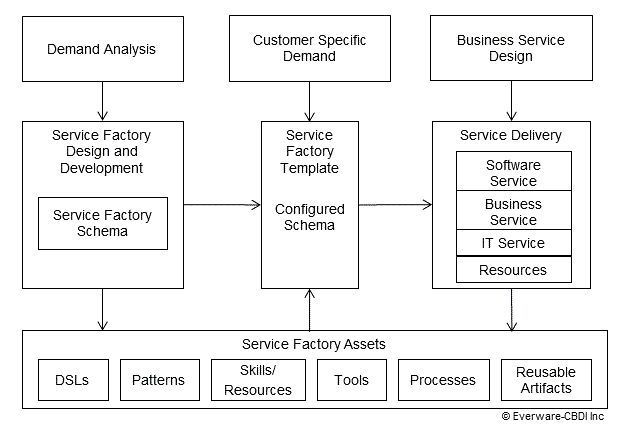
The Service Factory 2.0 will be a software factory separate from solution delivery projects. As discussed some firms already employ this organizing model in order to architect and design services to standardize core business information and rules for use in many processes.

The software factory concept has been in use for some time, particularly in conjunction with the Product Line concept, where common components are delivered using a framework of tools, repeatable processes and patterns, that are reused in solutions supporting the Product Line. The Service Factory 2.0 is a specialization of the software factory, with a framework that is specific to services. However the most effective service factory will also be a “business service” delivery model in which the life cycle of the business, software and IT service perspectives are integrated.

We can anticipate a number of critical innovations that will enable the Service Factory 2.0:

1. Everything is a Service All business capabilities are delivered as modular software services which are integral to the holistic business service offering.
2. Automated Requirements Capture. The requirements activity is automated in a manner that facilitates the involvement of the real stakeholders in the specification of the business, software and IT service, in a language that is entirely natural to them and to engage meaningfully in distributed Agile processes.
3. Automation of Common Service Patterns. The Service Factory frameworks that bootstrap service implementations will increasingly automate many of the common architectural and business model styles. Yet unlike the de facto application package products, the Service Factory will facilitate the extension and customization of the common pattern to allow competitive differentiation for the customer organization, as well as ongoing flexibility.
4. Service Portfolio Management. The Service Factory must support the management of the “business service” and provide tools that integrate demand management, architecture and governance over a composable and constantly evolving business and software service portfolio.
6. Pattern R&D. An important role of the service factory will be to continuously evolve patterns to enable and support innovation in styles of business service together with increased scope of automation coverage
7. Architecture Managed Iteration. Pattern based development delivers code that is always compliant with the architecture, but also with meta data that allows full automation of configuration management. This facilitates continuous, low effort iteration in the delivery, test, DevOps cycle and evolution in production.

In their paper, Chase and Garvin quote Drucker who noted that the imperatives of information-based competition are breaking down barriers within businesses and making functional divisions obsolete. To my mind, the primary characteristic of Service Factory 2.0 will be the realization of the business, software and IT service as a composite offering, architected, designed and delivered as a business asset.

[1]  The Service Factory, Chase, Garvin, HBR

Link: Everware-CBDI Service Factory as a Service

Agile SOA in the Digital Economy

Are you and your enterprise a prisoner of the past? I don’t mean legacy applications and technologies, I mean today’s business processes and applications. I work with many different enterprises and what’s common to the great majority is the centrality of business processes and applications, and the difficulty in evolving these existing solutions.

Actually I am frequently amazed at the understanding of many business managers. I marvel at how they use the lingua franca of their applications to describe their business. I will readily admit that when I first meet someone like this it’s a bit scary, because their vocabulary is like a foreign language. But frequently I find that it’s also a foreign language to their colleagues and it represents a rather primitive form of power play! Believe me. And that vocabulary of course often pervades the business process also. But the even scarier thing is that these organizations don’t realize they are locked into yesterday; or looking in the rear view mirror is you prefer. And just like Fred Brooks mythical beasts, struggling against the grip of the tar pits [1], they will eventually be overwhelmed by the complexity and their inability to change. Yes they may be delivering Cloud based Web and mobile applications to their customers, but are they just adding to the inherent business complexity?

I observe smart, successful companies making major mistakes as they enter the digital economy. First they set up an eServices project or division. This is treated as an innovation center and separated from the core business, in order to get to market quickly. But of course when they get to market the new products don’t integrate with the core business. Sure there’s application and service integration, anyone can patch old and new together at that level; but what about the way the business works; the business model and the vocabulary used, the opportunities for channel switching, and the development of distinctive sales and customer support systems and internal and external company culture that transcends the technology channels. And the ability to evolve the old and new in a way that they complement each other?

This problem is visible in the decreasing agility of organizations. Many have adopted Agile development but, and I say this as a certified Scrum Master, how many Agile projects think about the vocabulary and integrated business model issue? Yes Agile projects generally deliver faster, better and cheaper, but are they basically adding to the size and eventual grip of the tar pit? Just getting there faster!

In the digital economy enterprises must turn themselves inside-out! Expose their core business capabilities as services through multiple, interconnected channels for internal and external use. Today’s SOA best practice is primarily inwards looking. What’s required is a new form of business model that details the new world from the customers’ perspective. And this needs to be reflected in the way the business operates internally also.

The new business model needs to be a radical departure from de facto practices in business architecture, enterprise architecture or business requirements. And it needs to be developed to govern Agile development projects. Key characteristics include:
– A service oriented business model that transcends business and IT.
– Understandable by all stakeholders
– Owned by the business.
– All enterprise capabilities are (eventually) published as externalized business services and supported by common software services
– Implementation independent models
– Developed as part of an Agile process – initial scoping sprint, followed by drill down modeling sprints by domain and or capability; delivering just sufficient detail to charter Agile delivery projects.

[1] The Mythical Man-Month, Fred Brooks, 1972

Agile SOA in the Digital Economy

Are you and your enterprise a prisoner of the past? I don’t mean legacy applications and technologies, I mean today’s business processes and applications. I work with many different enterprises and what’s common to the great majority is the centrality of business processes and applications, and the difficulty in evolving these existing solutions.

Actually I am frequently amazed at the understanding of many business managers. I marvel at how they use the lingua franca of their applications to describe their business. I will readily admit that when I first meet someone like this it’s a bit scary, because their vocabulary is like a foreign language. But frequently I find that it’s also a foreign language to their colleagues and it represents a rather primitive form of power play! Believe me. And that vocabulary of course often pervades the business process also. But the even scarier thing is that these organizations don’t realize they are locked into yesterday; or looking in the rear view mirror is you prefer. And just like Fred Brooks mythical beasts, struggling against the grip of the tar pits [1], they will eventually be overwhelmed by the complexity and their inability to change. Yes they may be delivering Cloud based Web and mobile applications to their customers, but are they just adding to the inherent business complexity?

I observe smart, successful companies making major mistakes as they enter the digital economy. First they set up an eServices project or division. This is treated as an innovation center and separated from the core business, in order to get to market quickly. But of course when they get to market the new products don’t integrate with the core business. Sure there’s application and service integration, anyone can patch old and new together at that level; but what about the way the business works; the business model and the vocabulary used, the opportunities for channel switching, and the development of distinctive sales and customer support systems and internal and external company culture that transcends the technology channels. And the ability to evolve the old and new in a way that they complement each other?

This problem is visible in the decreasing agility of organizations. Many have adopted Agile development but, and I say this as a certified Scrum Master, how many Agile projects think about the vocabulary and integrated business model issue? Yes Agile projects generally deliver faster, better and cheaper, but are they basically adding to the size and eventual grip of the tar pit? Just getting there faster!

In the digital economy enterprises must turn themselves inside-out! Expose their core business capabilities as services through multiple, interconnected channels for internal and external use. Today’s SOA best practice is primarily inwards looking. What’s required is a new form of business model that details the new world from the customers’ perspective. And this needs to be reflected in the way the business operates internally also.

The new business model needs to be a radical departure from de facto practices in business architecture, enterprise architecture or business requirements. And it needs to be developed to govern Agile development projects. Key characteristics include:
– A service oriented business model that transcends business and IT.
– Understandable by all stakeholders
– Owned by the business.
– All enterprise capabilities are (eventually) published as externalized business services and supported by common software services
– Implementation independent models
– Developed as part of an Agile process – initial scoping sprint, followed by drill down modeling sprints by domain and or capability; delivering just sufficient detail to charter Agile delivery projects.

[1] The Mythical Man-Month, Fred Brooks, 1972

Enterprise Architecture as Science?

It is common to describe Enterprise Architecture as a science. Here are a few examples.

  • We see enterprise architecture (EA) as a scientific sub-discipline both of computer science and business management. The twice mentioned word “science” here emphasizes our certainty that EA is an exact discipline able to produce precise approaches and solutions. Wolf Rivkin, Enterprise Architecture and the Elegant Enterprise (Architecture and Governance 5-3)

A few years ago, I discussed this question with @RSessions

Roger is one of the few people I know who is seriously committed to empirical investigation of EA. I believe he shares my view that much EA falls woefully short of anything like scientific method. To my eye, many knowledge-claims within the EA world look more like religion or mediaeval scholastic philosophy than empirically verifiable science.

But why does it matter anyway? Why would people be so keen to claim EA as a science? Here is what Foucault had to say to those who wished to claim Marxism (or psychoanalysis) as a science.

“When I see you trying to prove that Marxism is a science, to tell the truth, I do not really see you trying to demonstrate once and for all that Marxism has a rational structure and that its propositions are therefore the products of verification procedures. I see you, first and foremost, doing something different. I see you connecting the Marxist discourse, and I see you assigning to those who speak that discourse the power-effects that the West has, ever since the Middle Ages, ascribed to a science and reserved for those who speak a scientific discourse.” Michel Foucault, Society Must be Defended: Lectures at the Collège de France, 1975-76 (English translation by David Macey, 2003)

In other words, claiming EA as a science is not about the rational basis for its knowledge-claims but about its authority, or what Foucault (in David Macey’s translation) calls Power-Effects. Thus instead of claiming EA as a science, one might follow Gartner in claiming EA as a discipline.


Enterprise architecture (EA) is a discipline for proactively and holistically leading enterprise responses to disruptive forces by identifying and analyzing the execution of change toward desired business vision and outcomes. EA delivers value by presenting business and IT leaders with signature-ready recommendations for adjusting policies and projects to achieve target business outcomes that capitalize on relevant business disruptions. EA is used to steer decision making toward the evolution of the future state architecture. (Gartner website, retrieved 17 August 2013)

Foucault characterizes a discipline in terms of the selection, normalization, hierarchicalization and centralization of knowledge. We can surely recognize these processes in the formation and maintenance of EA frameworks such as TOGAF and PEAF, as well as various attempts to construct Bodies of Knowledge. Foucault notes that “the progress of reason” necessitates “the disciplinarization of polymorphous and heterogeneous knowledge”. This might lead us to expect some institutional resistance to heterodox ideas, as well as the marginalization of “amateur scholars”.

Foucault is interested in ways that people and organizations can respond to disruptive forces large and small, from “great radical ruptures, massive binary divisions” to “mobile and transitory points of resistance, producing cleavages in a society that shift about, fracturing unities and effecting regroupings”.

Just as the network of power relations ends by forming a dense web that passes through apparatuses and institutions, without being exactly localized in them, so too the swarm of points of resistance traverses social stratifications and individual unities. And it is doubtless the strategic codification of these points of resistance that makes a revolution possible. [Michel Foucault, History of Sexuality Vol 1.]

Gartner’s notion of EA-as-discipline seems quite consistent with this. It is focused on mobilizing the response to disruptive forces (for which Gartner uses the rather strange word “nexus”). EA gains its power from a kind of strategic codification (or discursive practice), allowing the enterprise to “harness the nexus”, thereby “revolutionizing business and society, disrupting old business models and creating new leaders”. (Gartner website, retrieved 17 August 2013)


Update

@tetradian commented on the dangers of spurious ‘authority’ ‘spurious’ in sense of claiming an aura of ‘authority’ when there’s none to be had (b/c it isn’t ‘science’ anyway)

I agree that claims of scientific status or method in the EA world are generally spurious. But there are other ways of asserting authority. For me, the key question is why (and on what grounds) should anyone trust the pronouncements of EA. It is not just about danger versus safety, but about authority versus authenticity.

    Enterprise Architecture as Science?

    It is common to describe Enterprise Architecture as a science. Here are a few examples.

    • We see enterprise architecture (EA) as a scientific sub-discipline both of computer science and business management. The twice mentioned word “science” here emphasizes our certainty that EA is an exact discipline able to produce precise approaches and solutions. Wolf Rivkin, Enterprise Architecture and the Elegant Enterprise (Architecture and Governance 5-3)

    A few years ago, I discussed this question with @RSessions

    Roger is one of the few people I know who is seriously committed to empirical investigation of EA. I believe he shares my view that much EA falls woefully short of anything like scientific method. To my eye, many knowledge-claims within the EA world look more like religion or mediaeval scholastic philosophy than empirically verifiable science.

    But why does it matter anyway? Why would people be so keen to claim EA as a science? Here is what Foucault had to say to those who wished to claim Marxism (or psychoanalysis) as a science.

    “When I see you trying to prove that Marxism is a science, to tell the truth, I do not really see you trying to demonstrate once and for all that Marxism has a rational structure and that its propositions are therefore the products of verification procedures. I see you, first and foremost, doing something different. I see you connecting the Marxist discourse, and I see you assigning to those who speak that discourse the power-effects that the West has, ever since the Middle Ages, ascribed to a science and reserved for those who speak a scientific discourse.” Michel Foucault, Society Must be Defended: Lectures at the Collège de France, 1975-76 (English translation by David Macey, 2003)

    In other words, claiming EA as a science is not about the rational basis for its knowledge-claims but about its authority, or what Foucault (in David Macey’s translation) calls Power-Effects. Thus instead of claiming EA as a science, one might follow Gartner in claiming EA as a discipline.

    Enterprise architecture (EA) is a discipline for proactively and holistically leading enterprise responses to disruptive forces by identifying and analyzing the execution of change toward desired business vision and outcomes. EA delivers value by presenting business and IT leaders with signature-ready recommendations for adjusting policies and projects to achieve target business outcomes that capitalize on relevant business disruptions. EA is used to steer decision making toward the evolution of the future state architecture. (Gartner website, retrieved 17 August 2013)

    Foucault characterizes a discipline in terms of the selection, normalization, hierarchicalization and centralization of knowledge. We can surely recognize these processes in the formation and maintenance of EA frameworks such as TOGAF and PEAF, as well as various attempts to construct Bodies of Knowledge. Foucault notes that “the progress of reason” necessitates “the disciplinarization of polymorphous and heterogeneous knowledge”. This might lead us to expect some institutional resistance to heterodox ideas, as well as the marginalization of “amateur scholars”.

    Foucault is interested in ways that people and organizations can respond to disruptive forces large and small, from “great radical ruptures, massive binary divisions” to “mobile and transitory points of resistance, producing cleavages in a society that shift about, fracturing unities and effecting regroupings”.

    Just as the network of power relations ends by forming a dense web that passes through apparatuses and institutions, without being exactly localized in them, so too the swarm of points of resistance traverses social stratifications and individual unities. And it is doubtless the strategic codification of these points of resistance that makes a revolution possible. [Michel Foucault, History of Sexuality Vol 1.]

    Gartner’s notion of EA-as-discipline seems quite consistent with this. It is focused on mobilizing the response to disruptive forces (for which Gartner uses the rather strange word “nexus”). EA gains its power from a kind of strategic codification (or discursive practice), allowing the enterprise to “harness the nexus”, thereby “revolutionizing business and society, disrupting old business models and creating new leaders”. (Gartner website, retrieved 17 August 2013)


    Update

    @tetradian commented on the dangers of spurious ‘authority’ ‘spurious’ in sense of claiming an aura of ‘authority’ when there’s none to be had (b/c it isn’t ‘science’ anyway)

    I agree that claims of scientific status or method in the EA world are generally spurious. But there are other ways of asserting authority. For me, the key question is why (and on what grounds) should anyone trust the pronouncements of EA. It is not just about danger versus safety, but about authority versus authenticity.

      The New Normal

      bg outline

      Ben Geller, VP Marketing, Troux
       

      blog pic   good enough itRecently technology entrepreneur, lecturer and author Peter Hinssen delivered a keynote address at our annual worldwide conference. The premise of Mr. Hinssen’s presentation was based on his observation that we are beginning to embark on a new era where digital is just a ‘normality’.   Simply put, we have spent the last 25 years becoming digital and we are now entering an era where digitization and technology are expected to be part of our lives, at-home, at-work and on-the-go.

      He went on to say, once in the new normal we have a zero tolerance for failure, but at the same time we realize things do not always have to be perfect.  He coined the phrase “good enough technology” and stated good enough technology will become acceptable in the work place.   Good enough technology does not mean we cut corners.  It means that as we become more technology aware in our work lives we would be happy with solutions that are say eighty-percent perfect on the quality scale.   Mr. Hinssen stated in the case of the enterprise if we take a look at the classical way we build and develop IT applications and systems we know it can take a long time to attain one hundred-percent quality.  If businesses would be happy to take IT applications and systems that are eighty-percent perfect on the quality scale IT departments could probably deliver twice as many systems and applications in the same amount of time. 

      The difference between one hundred-percent and eighty-percent perfect on the quality scale is a dialogue with business – resulting in – good enough technology.   That’s where an Enterprise Portfolio Management (EPM) approach can help.  By identifying the connection between business goals and strategies to the applications and technology spread across the enterprise, business leaders can make application and technology investment decisions based on facts rather than gut feel.  This helps enterprises better define what ‘good enough’ investments look like and helps prepare the business to move forward with new projects with greater speed and agility – two key ingredients for success in the era of the new normal.

      Finally, Mr. Hinssen commented that if we look at the old normal and new normal together we can see that IT needs to evolve.  In the ‘old normal’ we used to design systems that were ‘built to last’, but in the new normal the pressures on IT are quite different.  We have to let IT evolve from the ‘built to last’ philosophy in the old normal to a ‘designed to change’ philosophy in the new normal.

      Once again an EPM-centric approach can help with this evolution.  Using EPM decision making principles (making IT decisions in the context of the business) enterprise architects can design fluid architectures that allow business leaders to embrace the ‘design to change’ philosophy ushered in with the era of the new normal.  Using an EPM approach, enterprise architects can help decision makers design and deliver disruptive new services or create new business models that leverage the technologies that are powering the new IT economy.  Technologies such as cloud, virtualization and mobility are now the currency of the new normal.  Using an EPM approach enterprise architects can show business leaders how these technologies can play a more integral part in delivering success across enterprise much faster – and help them build a wining business in the era of the new normal.

      Categories Uncategorized

      The “Right” Representation of the EA Value Cycle

      In the world of Enterprise Architecture, we are still creating “shared” understanding of how to tell our stakeholders what we do.  There is no consistency in our diagrams or our descriptions just yet.  This post will discuss the different ways we present the value stream of Enterprise Architecture and will attempt to select a particular viewpoint that can be useful for the majority of situations.

      First, let’s address the most commonly shared representation: TOGAF.  The TOGAF ADM model illustrates a sequence of activities that starts with a preliminary phase and works its way through each of the levels of architecture.  Basically, TOGAF illustrates a straight-through process from phase A through phase H to develop and use architecture. 

       image

      First off, I’m no huge fan of this illustration.  I always wondered how you get to an architectural vision prior to considering the architecture of the business.  Also, the notion of a center point focused around requirements management feels weirdly tactical.  At the level of an Enterprise Architect, I’m dealing with strategies and measures of success.  At the level of a technical architecture, the word “requirements” has an altogether different meaning.  Grouping together the notion of “strategic needs” with “technical requirements” may make sense to a technologist, but I don’t know a single business stakeholder of EA that would agree with grouping those two rather distinct things. 

      Who is our audience?

      These observations bring me to my first key consideration: If we want to communicate the value stream of Enterprise Architecture, we first should consider the audience, “who are we communicating to?”  If we are communicating to a stakeholder of EA, we should show them the bits of EA that are relevant to them, and we should not show them the bits that are not. 

      It is not cynical to gloss over the complex bits of EA when talking to a business stakeholder… it is practical.  In fact, we do it all the time.  If you buy cable TV services, a person from the cable company may come to your house and install a coax cable to your home.  He will mess around with a cable box for a few minutes, and then, if you are lucky, he will show you how to do simple things like changing channels and recording your favorite shows.  Then, he’s off.  He does NOT spend an hour describing the various technical aspects of signal transmission and digital carrier signals.  Why should he?  You don’t care.  You want to watch TV, not get a degree in electrical engineering.  And the same applies to EA.

      Secondly, if we want to communicate EA, let’s recognize that different people interact with Enterprise Architecture in different ways.  Business stakeholders will interact with Enterprise Architecture to ensure that their strategies are being executed effectively, with minimal interference, and producing a result that considers things like security, cost of ownership, and the ability to cope with rapid changes in the marketplace.

      Recap:

      1. We have to care who we are speaking to, and we have to reflect the things that they care about.
      2. We have to show them the details that matter to them and obscure the details that don’t.
      3. We should illustrate the activities in the context of the processes that they understand, and not at a conceptual level that may be difficult to relate to their daily experience.


      The ADM from TOGAF is an odd bird, because it attempts to be all things to all people.  It represents EA in a way that every stakeholder can use, but honestly, no stakeholder can use it.  It is not wrong.  Far from it.  But it is not useful because it violates every single one of the rules above.  The ADM reflects the EA viewpoint, but not the viewpoint of the customers of EA at a level that they can grasp, understand, and most importantly, use.  So let’s keep the ADM in our court, and create a view of the EA process that is relevant to our stakeholders.

      So who are our stakeholders?  For the sake of this post, I’m going to select one set of stakeholders and ignore the rest.  Is that correct?  Nope, but it is practical for a blog post.  What this means is that the rest of this post produces an answer of the “right” representation only for one class of stakeholders… another representation would likely be needed for different people.  That is the nature of EA.  Let’s not fret it.

      Stakeholders: Non-technologists

      There is a widely held view in Enterprise Architecture that an EA must be technically savvy in order to be effective.  There are certainly business architects who are quite effective who are not technologists, but in order to move UP to the notion of an EA (which includes business architecture, information architecture, solution or application architecture, AND technology architecture), you would need to be technically capable. 

      I won’t belabor the point about whether it is correct to view Business Architecture as a subset of Enterprise Architecture.  It is the wildly predominant view.  (A poll that I put on LinkedIn that asked this question found that well over 80% of EA respondents agree that EA generally includes every aspect of business architecture.  That’s pretty overwhelming.)

      That said, our biggest struggles in EA rarely involve conversations with other architects.  While there may be a great deal of confusion, there is rarely a lack of buy-in for architecture among architects, or even technologists.  Our key challenge, when it comes to communication, comes when we are talking to non-technologists.  In other words, the proverbial “business” stakeholders of EA.  (Please don’t flame me about whether IT is part of the business or not. That is a useful conversation, but it is outside the scope of this post).

      Therefore, for the rest of this post, I will focus on the non-technology stakeholders of Enterprise Architecture.  These are people whose chief concerns are not technical concerns.  We could say that they care about financial performance, role clarity, cycle time, cost effectiveness, market position, revenue growth, opportunity costs, business drivers, and many other factors outside the realm of technology concerns.  People in this category include senior business leaders (CEO, COO, CFO, CIO, CMO, etc), as well as business unit leaders (General Managers, Sales Division Leaders, Product Development and Marketing, Customer Service, Online Services, etc). 

      In order to communicate directly and well to these folks, lets recognize that they don’t care about the aspects of architecture that are technology focused.  While the WANT good technology, and will BENEFIT from good technology, they will assume that the technology issues can be handled effectively without bothering them with details.  To refer to our previous metaphor, they want the cable company to handle the technology, so that they can deal with changing channels.

      So, let’s take the ADM, and trim out the stuff that non technologists rely on, but don’t need to have a conversation about.  They assume it is there.  That includes the preliminary stage, as well as architectural vision, requirements management, information systems architecture, technology architecture, and architecture change management.

      The ADM now looks a bit different.  In fact, we can put it in a single row with a looping arrow.  Note that, in TOGAF, the Business architecture phase includes both current state assessment and future state modeling.

      image

      Representing the processes of the non-technical stakeholder

      We have removed the confusing bits from the view of the non-technical stakeholder, but it is tough to say that we are at the point where we are relevant.  After all, the non technical stakeholder has a business process that he uses when working with changes to his or her business.  We are not representing that process. 

      The process, frequently described in dozens of bits of EA literature, starts with an understanding of the current situation within the business.  Then, when the business creates a strategy, we bring these two bits of information together (current state and strategy) to create a vision for the future.  This is the order that the non technical stakeholder may recognize… not the generalized view of the ADM.  So it is time to break apart and rearrange the bits a little bit.  I will now step away from the “crop circles” representation since it is so far out of the experience of people who describe business processes.

      image

      In this view, we can begin to see the steps that an Enterprise Architect would perform that are visible to a non-technical stakeholder.  Just for the sake of clarity, this doesn’t mean that the technical steps are absent… it just means that our technical efforts don’t have to be paraded around in front of our non-technical stakeholders. 

      Note that I relabeled the ADM steps. 

      • Business Architecture becomes Current State Evaluation, and Strategy Development
      • Opportunities and Solutions becomes Future State Modeling
      • Migration Planning becomes Roadmap Development
      • Implementation Governance becomes two things: Funding and Initiation (the Project Portfolio Management aspects) and Oversight and Governance (the governance of ongoing activities).
      • Architecture Vision is cut down to only the elements relevant to the non-technical stakeholders: the evaluation of the current state of the enterprise.


      Let me point out that the TOGAF process assumes a different order of activities than the diagram above.  From the standpoint of the stakeholder, this is what makes sense, regardless of how TOGAF describes the stages.  This is why I’m no big fan of TOGAF as a methodology.  It doesn’t reflect reality.  On the other hand, the elements above are fairly well understood. 

      Also note that I’m not saying that the substitutions listed above are equivalent.  In fact, I’d argue violently that Business Architecture is far more than Current state evaluation and Strategy Development.  However, from the viewpoint of the non-architect, business architecture is a process that is involved with the development of business models (current and future), and that’s about it.  There is a great deal of effort that is not seen by the stakeholders.

      In other words, the blue model above is only showing the tip of the iceberg, and relabeling the phases according to what is (approximately) visible, not what is actually there. 

      This is an important part of explaining an activity to a stakeholder, and it is a skill that every Enterprise Architect must get good at.  You have to explain your activities in the context of what a stakeholder understand and recognizes… not in the context of all your work.  It’s not about you. It’s about the stakeholder.


      The Rules of Value Streams

      There are a few problems with the view above.  In order to understand the problems with that view, let’s mention a couple of rules for representing a value stream.  We will use these concepts because the ability to describe EA in terms of a value stream is important.  Value streams are sticky… they are easy to remember and easy to relate to.  If we want to remove the barriers to adoption of EA, we could do far worse than using this technique.  That said, there are some rules that we have to keep in mind:

      1. A value stream does not illustrate dependencies that are not really there.  Parallel efforts should be represented as parallel if that would improve understanding of how value is created.
         
      2. The value stream is illustrated as a sequence of high level processes in a straight line from left to right.  That said, a value stream must start with an event that is relevant to the customer who gets value.  It must end with the deliver of that value.  Any activity that is not part of that flow (from relevant starting point to value) should be represented “above” or “below” the value stream.  
         
      3. A value stream should be illustrated in its fully operational state.  In other words, it should describe a process that is running, not one that hasn’t been created yet.  Events that are relevant only for “start-up” activities can be included, but should not be the primary focus of a value stream.


      So let’s apply rule #1.  Is it true that the current state of the organization actually feeds the development of strategy?  No.  In fact, the evaluation of the current state can happen completely in parallel to the development of business strategy. 

      So the diagram could look like this one.

      image

      Here, we can see that there are, in fact, parallel activities for the understanding of the current state of the enterprise, and for the development of business strategy.  Where they first intersect is in the development of the future state (the opportunities and solutions phase from the ADM model).  You need both an understanding of the current situation and the needs of the future in order to describe where the organization should move towards. 

      Now, let’s apply rule #2.  What is the event that the business considers to be relevant to start the value stream of Enterprise Architecture?  The Development of Business Strategy, of course.  So the flow should perhaps look more like the diagram below… (note, the arrows and activities are identical to the one above… the only thing different is the order on the page).

      image

      Now, let’s apply rule #3… that one is easy.  The arrow at the bottom that says “First TIme EA” can simply be dropped.  After all, the first time a process is run, it starts from somewhere.  It is simply irrelevant to the non-technical stakeholder to point out where that starting position is. 

      Exception: if you run Enterprise Architecture as a consulting arrangement, you may want to leave that arrow in there.  After all, you will need to illustrate where the consulting arrangement will start.  That said, I have found that fewer and fewer EA initiatives begin with the hiring of a consulting firm. 

      Providing context

      When we started with the ADM, we assumed that there was a 700+ page methodology and framework behind the image, describing each step and what is included.  However, your stakeholder will not read the TOGAF or any other 700+ page body of information.  That would be absurd.  You need to add a little detail to the image to describe what is in each of these stages.

      It’s also a good idea to “clean up” the diagram a little so that we use less space on the “arrows and boxes” and more engagement on the ideas of what is going on.  So the next modification of the process looks like this:

      image

      This diagram is a better one for informing the non-technical stakeholders of your Enterprise Architecture program about what it is that you do.  We remove a little of the “accuracy” about where an arrow starts and ends, but we add a great deal of context about what is happening along the way.

      The “backward” arrow along the bottom clearly indicates that there are activities that flow outside the value stream but which are needed for each repeat of the cycle. 

      Final words

      Is this a perfect representation of the EA process?  I don’t believe in perfect things… just useful things.  But it is better, in my opinion, than showing a non-technical stakeholder the ADM or one of the “box and arrow” models above.  It uses the visual language of value streams and business process models, both widely recognized and used in business interactions.  It explains itself without going into a lot of detail.  And it clearly describes the end to end flow without restricting or dictating where Enterprise Architects start and stop (an important requirement, since maturing EA programs will change their scope as they mature).

      I have shown this view to others, and some have wondered about the “backward flowing” process along the  bottom.  The alternative to showing something as “backward flowing” would be to illustrate it as a cycle (with arrows feeding “in” from the right and “out” from the left).  If it is a challenge for you to view the diagram without those arrows, I apologize.  I’d love to see other view of this model that illustrate the “cycle” in a way that still meets the “rules of the value stream” as discussed above.

      I’d love to get feedback and insight from the community.  What do you think?  Does the last image above resonate?  What would you do differently?

      Top Technology Trends and CIO Priorities for 2013

      I have been regularly writing about emerging Information Technology trends on this blog. The CIO priorities for future are often linked to these trends but they also do influence the Information Technology trends in return. Gartner who is at the forefront of research in this space has recently released their research report outlining their top 10 strategic technology trends for 2013. The complete report can be accessed here but a brief summary of this research along with my own summary comments are as follows:
      1. Mobile Devices Battles – Windows 8 is here. Is your organisation going to deploy it? If yes, what will be the impact on your BYOD policy. Windows 8 tablets and smartphones will gain in prominence. What does this mean for your iOS and Android support model?
      2. Mobile Apps and HTML 5 –  Mobile app and web technologies are fast maturing and are influencing native application development too. How will you manage the hybrid web / native development frameworks?
      3. Personal Cloud – Online applications and services are transforming consumer technology. How will this effect your organisation? Windows 8 with Skydrive is an example of this trend.
      4. The Internet of Things – Becoming more mainstream now. What innovative business models will you create in next three years to benefit from IoT?
      5. Hybrid IT and Cloud Computing – As Cloud Computing evolves and matures new business and operating models are emerging. IT departments of large oranisations will be expected to act as service brokers in such hybrid models.
      6. Strategic Bid Data – Big Data has become a major driver of IT spending recently but going forward the trend will be to integrate this better with Data warehouses and Data Integration Infrastructure
      7. Actionable Analytics – Business needs real-time decision making and forward looking analytics. How can you embed this in real time applications?  
      8. Mainstream In-Memory Computing – How will In-Memory Computing disrupt the application architectures and how will your manage the operating and data governance requirements?  
      9. Integrated Platforms and Ecosystems – How do you balance vendor lock-in with benefits of integrated platforms?
      10. Enterprise APP Stores – The success of consumer App stores will drive organisation’s own enterprise App stores but this needs to balanced with security and support concerns.
      Deloitte has been a recent welcome entrant in the Technology Trend publishing business with it releasing its fourth annual technology trend report recently. The folks at Deloitte have taken an interesting approach to this as they have grouped trends in two classifications or categories:  “Disruptors” are opportunities that can create sustainable positive disruption in IT capabilities, business operations, and sometimes even business models. “Enablers” are technologies in which many CIOs have already invested time and effort, but which warrant another look because of new developments or opportunities. Deloitte lists trends such as Influence of Mobility, Social, Analytics, Cloud as Disruptors while listing as Gamification, Refocussing on ERP and Security focus as Enablers. 

      In one of my previous blog posts I had written about five forces shaping the CIO agenda. Very briefly, they were listed as, Business Services, Application Services, Cloud Computing, Consumerisation of Technology and Business Analytics. If above published 2013 trend research is taken into account then I would like to redefine them as follows:

      1. Evolution of Cloud Computing – Private, Public, Hybrid, Community, Personal
      2. Consumerisation of Technology – Windows 8, Tablet, Smart phone adaption
      3. Mainstream nature of Data Analytics – Big Data coming to Data Warehousing 
      4. Proliferation of Web APPs – Enterprise APP stores on the line of Mobile APP Stores
      5. Increasing Integration of Platforms – e.g. Rise of Appliances such as EXADATA
      I think that the business and application services are slowly merging into the APP Store philosophy while the business analytics has gone mainstream since 2011. Cloud and increasing integration of platforms is a trend which has matured since past few years and is probably going to get through further rounds of evolution in coming years. It is interesting that no one is yet talking about explicit influence of Social as much as any of above trends. 

      Top Technology Trends and CIO Priorities for 2013

      I have been regularly writing about emerging Information Technology trends on this blog. The CIO priorities for future are often linked to these trends but they also do influence the Information Technology trends in return. Gartner who is at the forefront of research in this space has recently released their research report outlining their top 10 strategic technology trends for 2013. The complete report can be accessed here but a brief summary of this research along with my own summary comments are as follows:
      1. Mobile Devices Battles – Windows 8 is here. Is your organisation going to deploy it? If yes, what will be the impact on your BYOD policy. Windows 8 tablets and smartphones will gain in prominence. What does this mean for your iOS and Android support model?
      2. Mobile Apps and HTML 5 –  Mobile app and web technologies are fast maturing and are influencing native application development too. How will you manage the hybrid web / native development frameworks?
      3. Personal Cloud – Online applications and services are transforming consumer technology. How will this effect your organisation? Windows 8 with Skydrive is an example of this trend.
      4. The Internet of Things – Becoming more mainstream now. What innovative business models will you create in next three years to benefit from IoT?
      5. Hybrid IT and Cloud Computing – As Cloud Computing evolves and matures new business and operating models are emerging. IT departments of large oranisations will be expected to act as service brokers in such hybrid models.
      6. Strategic Bid Data – Big Data has become a major driver of IT spending recently but going forward the trend will be to integrate this better with Data warehouses and Data Integration Infrastructure
      7. Actionable Analytics – Business needs real-time decision making and forward looking analytics. How can you embed this in real time applications?  
      8. Mainstream In-Memory Computing – How will In-Memory Computing disrupt the application architectures and how will your manage the operating and data governance requirements?  
      9. Integrated Platforms and Ecosystems – How do you balance vendor lock-in with benefits of integrated platforms?
      10. Enterprise APP Stores – The success of consumer App stores will drive organisation’s own enterprise App stores but this needs to balanced with security and support concerns.
      Deloitte has been a recent welcome entrant in the Technology Trend publishing business with it releasing its fourth annual technology trend report recently. The folks at Deloitte have taken an interesting approach to this as they have grouped trends in two classifications or categories:  “Disruptors” are opportunities that can create sustainable positive disruption in IT capabilities, business operations, and sometimes even business models. “Enablers” are technologies in which many CIOs have already invested time and effort, but which warrant another look because of new developments or opportunities. Deloitte lists trends such as Influence of Mobility, Social, Analytics, Cloud as Disruptors while listing as Gamification, Refocussing on ERP and Security focus as Enablers. 

      In one of my previous blog posts I had written about five forces shaping the CIO agenda. Very briefly, they were listed as, Business Services, Application Services, Cloud Computing, Consumerisation of Technology and Business Analytics. If above published 2013 trend research is taken into account then I would like to redefine them as follows:

      1. Evolution of Cloud Computing – Private, Public, Hybrid, Community, Personal
      2. Consumerisation of Technology – Windows 8, Tablet, Smart phone adaption
      3. Mainstream nature of Data Analytics – Big Data coming to Data Warehousing 
      4. Proliferation of Web APPs – Enterprise APP stores on the line of Mobile APP Stores
      5. Increasing Integration of Platforms – e.g. Rise of Appliances such as EXADATA
      I think that the business and application services are slowly merging into the APP Store philosophy while the business analytics has gone mainstream since 2011. Cloud and increasing integration of platforms is a trend which has matured since past few years and is probably going to get through further rounds of evolution in coming years. It is interesting that no one is yet talking about explicit influence of Social as much as any of above trends. 

      Multi-Sided Platform Strategies

      A multi-sided platform business has the following characteristic features.

      1. The platform serves two or more distinct categories of customer. For example, a credit card platform serves both cardholders and merchants. For example, a heterosexual dating agency serves both men and women.

      2. The platform provides a mechanism for connecting customers from different categories. The credit card increases the potential interaction between cardholders and merchants, as well as processing the transactions. And the dating agency brings men and women together.

      3. The value of the platform to one category of customers depends on the quantity and quality of the other categories. For example, the value of a credit card to the cardholder depends on the number of merchants that accept the card. Meanwhile, the value of the card to the merchant depends on the number of cardholders.

      Under certain circumstances, it might be possible to build one side of the platform first. For example, if you had some brilliant idea for a entirely new kind of credit card, and had a lot of funding and a persuasive sales team, you might conceivably be able to recruit a large number of merchants into the scheme before you had any cardholders at all. Or imagine persuading a group of men to invest all their spare time for two years building a nightclub that would (when finished) attract the hottest women in the city. But this strategy requires a considerable degree of confidence and trust. So in practice it usually makes sense to build up both sides at the same time.

      There are various strategies that can be used to create a multi-sided platform. Sometimes it is possible to start small. When Frank McNamara created Diners Club in 1950, he started in a small geographical area (Manhatten), with 14 merchants and a few hundred cardholders. Within a year, he had 300 merchants and 40,000 cardholders.

      When American Express wished to enter the market in 1958, it needed to create something quickly that could compete with Diners Club. One way to do this was to acquire and consolidate some existing schemes. But the key element to the American Express’s success was a marquee strategy – recruiting the most desirable customers (e.g. business travellers on expense accounts) and the most desirable merchants (e.g. high status hotels, restaurants and stores).

      A marquee strategy depends on a degree of exclusivity, real or imagined. In a multi-sided market, you don’t gain directly from the number of people on your own side, since they may be competing with you for the attention of the people on the other side.

      American Express is now much larger than Diners Club. So much for first-mover advantage then. The most desirable customers are not necessarily the ones with the greatest willingness to experiment with a novel platform. Novel platforms tend to attract early adopters and low-value customers (AltaVista, MySpace, OnSale). Once the platform concept is understood, a new entrant may be more successful in recruiting the high-value and mainstream customers (Google, Facebook, eBay).

      Among users of Facebook and Twitter, a gulf is emerging between celebrities and other users. Facebook is currently experimenting with charging a fee for ordinary users to send messages to celebrities. According to the Independent, Facebook plans to keep this money itself. Presumably the only benefit to the celebrity is helping to filter incoming messages. And of course many celebrities are now dependent on Facebook and Twitter for maintaining their public profile, so they are not able to walk away.

      The growing distinction between different categories of user marks a transition from same-side network effects (which assume a single category of user) into a multi-sided platform. Linked-In is another platform that is making this transition. Linked-In gets much of its revenue from the recruitment business, so it is essentially a market-making platform. Whereas Facebook and Twitter remain largely audience-making platforms.

      (For the distinction between market-making and audience-making platforms, as well as a third category of demand-coordination platforms, see David S Evans.)

      I shall be talking at the IASA UK Architecture Summit on 26th April on Architecting the Multi-Sided Business. There is more extensive coverage in my Business Architecture Workshop. Please contact me if you have any practical challenges in this area.


      Pieter Ballon, Platform Types and Gatekeeper Roles: the Case of the Mobile Communications Industry (2009)

      Mark Bonchek and Sangeet Paul Choudary, Three Elements of a Successful Platform Strategy (HBR Blog Network Jan 2013)

      David S. Evans, Managing the Maze of Multisided Markets (Strategy+Business Fall 2003)

      David S. Evans, The Antitrust Economics of Multi-Sided Platform Markets (Yale Journal on Regulation, 2003)

      David S. Evans and Richard Schmalensee, Failure to Launch: Critical Mass in Platform Businesses (Sept 2010)

      Thomas Eisenmann, Geoffrey Parker, and Marshall W. Van Alstyne, Strategies for Two-Sided Markets (HBR October 2006)

      James Legge, Facebook now charges you for messages sent to celebrities and people you aren’t friends with (Independent 7 April 2013)

      Lisa O’Carroll, Facebook starts charging users up to £11 to contact celebrities (Guardian 8 April 2013)

      Geoffrey Parker and Marshall Van Alstyne, A Digital Postal Platform: Definitions and a Roadmap (MIT Jan 2012)

      Richard Veryard, The Component-Based Business: Plug and Play (Springer 2001)

      Understanding LinkedIn Business Model (BMI Matters May 2012)

      Thinking About Big Data

      As the consumerization of technology continues to grow and converge, our way of constructing business models and systems need to evolve as well. We need to let data drive the business process, and incorporate intelligent machines like Watson into our infrastructure to help us turn data into actionable results. … Continue reading