The Curious Case of the Courts’ CIO: How ACM Solves the New Service Delivery Challenge

“Let’s start 2013 by considering how the CIO function can deliver new solutions to your enterprise when as much as 80 percent of the IT budget goes to just keeping the lights on, maintaining your current systems. With market conditions forcing increased cost cutting, and a distinct trend to place more of the technology decision making and buying power in the hands of the business, the mystery of successful delivery is getting harder for the CIO to solve.”

Related posts:

  1. How Adaptive Case Management Can Help in the Battle for Same Day Delivery “In this article, I take a look at the latest…
  2. Case Management Top Influencers Study: System Integrators and Vendors Driving Case Management Knowledge, Growth, Adoption and Evolution Continuing our series of articles announcing The Case Management Top…
  3. Business optimization is the biggest challenge for German banks According to a study conducted by Capgemini and analyst firm…

Related posts brought to you by Yet Another Related Posts Plugin.

Data Governance: A Fundamental Aspect of IT

Underlying both SOA governance and Cloud governance is a fundamental aspect that we have been dealing with ever since the dawn of IT—and that’s the data itself. Let us challenge ourselves with a few questions. Consider them the what, why, when, where, who and how of data governance. Continue reading

Togaf and GERAM

[amazon_image id=”3642055664″ link=”true” target=”_blank” size=”medium” ]Handbook on Enterprise Architecture (International Handbooks on Information Systems)[/amazon_image] Some time ago I read this book on Enterprise Architecture, which is a compilation of various chapters about the GERAM framework for Enterprise Architecture. Now, while very extensive it seems that GERAM is dead. The last publications on the standard date […]

Het bericht Togaf and GERAM verscheen eerst op Rob Vens.

EA Roadmap for success: the Architecture Board

<p>This is the fourth posting in our “EA Roadmap for success” series. In this posting we zoom in on the <em>Architecture Board </em>and its role in making enterprise architecture a success within organizations.</p><h2/><h2><div class=”captionImage left” style=”width: 337px;”><img class=”left” src=”http://www.bizzdesign.com/assets/BlogDocuments-2/Role-of-the-architecture-board.png” alt=”Role of the Architecture Board” title=”Role of the Architecture Board” width=”337″ height=”221″/><p class=”caption”>Role of the Architecture Board</p></div></h2><h2>Architects show up everywhere</h2><p>One of the things we stumble across in many organizations is that some people see ‘architect’ as a job title rather than a strategic discipline. The line of reasoning being something along the lines of “first you’re a designer / engineer / …, then you’re a really good senior designer / engineer / …, so if you progress from there, well, I guess that makes you an architect”. While there’s something to be said for senior staff to grow further, there is a real danger in calling them architect.</p><p>A key aspect of enterprise architecture work, is the holistic approach in which different perspectives on some system (business, it, or the enterprise at large) are unified and considered as a whole. Being an expert in one role, does not guarantee that one has the ability to “see the other perspective” as well, which may result in architects coming from different disciplines bickering about direction and solutions which eventually leads to high cost, low value add, low efficiency and a poor reputation.</p><p>An important task of the architecture board (AB) is to prevent this from happening. In the words of the TOGAF standard:</p><p><em>“This body should be representative of all the key stakeholders in the architecture, and will typically comprise a group of executives responsible for the review and maintenance of the overall architecture.</em>”</p><p>Typical responsibilities of the AB are:</p><ul><li>Establish an effective architecture team</li><li>Defining and maintaining consistency of architectures and sub-architectures, also across changing requirements with respect to the architecture</li><li>Enforce architecture compliance</li><li>Ensuring that the discipline of architecture-based development is adopted</li><li>Resolving ambiguities, issues, or conflicts that have been escalated</li><li>Providing advice, guidance, and information about the architecture</li></ul><p>These tasks get a different meaning, depending on the role of the EA-function in the organization. Below we will outline the main difference between the role of the AB in a top-down versus a bottom-up approach.</p><h2>Role of the AB in a top-down approach</h2><p>As we’ve seen in previous posts of this series, the main goals for EA in a top-down approach are to align with the strategic level of the organization. At first sight this implies that EA is about the implementation of strategic change. However, it should be noted that there is also the aspect of driving strategic change based on knowledge about the architecture of the enterprise.</p><p>In such approach, the main goal of the EA discipline is to be the linking pin between strategy and implementation: define projects and programs and make sure they deliver capabilities that help realize a chosen strategy. Of course, as we also have seen in the “embedding” post, the AB cannot do this in isolation, and has to cooperate with e.g. project management and delivery to make things happen. </p><p>Governance plays a crucial role in such approach. On the one hand the AB defines and approves projects. On the other, it works with other governance bodies (ie., security governance, data governance, etc.) at “lower levels” in the organizations, aligning their efforts and giving final approval / discharge when projects are done.</p><p>In that sense, the AB also has the responsibility to be an <em>enabler</em>: projects need resources (rooms, staff, machines, money etc.) to do their work effectively. If the organization wants to achieve certain results, and the AB is tasked with making this happen, then they should also have the power to make sure that projects obtain these resources. Since resources tend to be scarce, this usually results in a balancing act, working on priorities and risks, and closely cooperate with the project management office.</p><p>Last but not least, it should be noted that change does not happen overnight and is frequently met with resistance in the organization. The AB plays an important role in communication, building trust and commitment around certain (strategic) initiatives and the resulting change.</p><h2>Role of the AB in a bottom-up approach</h2><p>The role of the AB in a bottom-up approach to EA is somewhat similar, but with different accents. In a bottom-up approach, the focus of EA is on resolving operational issues, and assisting projects with sound architectural advice.</p><p>In this case, the role of the AB can also be seen as “enabler”: making sure that operational issues are prioritized, that resources are allocated accordingly, and bringing together different perspectives on these operational issues in order to resolve them as effectively as possible. We frequently see that the AB is populated with (upper) management in order to make sure that decisions can be made, that the right staff is brought together in mini-projects to tackle important issues head on. This avoids the bureaucratic hassle as well as “not invented here” syndromes.</p><h2>Board structure</h2><p>To conclude this posting we dive into the board structure. This part is inspired by the TOGAF 9.1 standard as well as several engagements with clients over the last few years.</p><p>First of all, key to success is to get the right people on board. In both a top-down and a bottom-up approach, we typically see a mix of (senior / upper) management and lead architects for different ‘domains’ (which in this context may either mean ‘field of expertise’ such as data or security, or it may mean a line of business). A management assistant to take notes, log action items etcetera tends to be indispensable as well.</p><p>This brings us to the second issue: key to success is transparency.  Everything the AB does, and particularly every decision that is made should be documented and made available for the entire organization. This greatly improves trust and visibility, which is key to getting results. Typical items for publication are:</p><ul><li>A manifesto that describes the role and responsibilities for the AB</li><li>Agenda of upcoming meetings </li><li>Minutes of all AB-meetings</li><li>Links to <em>architecture regulations </em>such as strategies, policies, principles and standards</li><li>Compliance assessments and Governance log </li><li>Open and past action items</li><li>Etcetera</li></ul><p>If you’d like to know more, please contact the authors directly at <a title=”b.vangils@bizzdesign.com” href=”mailto:b.vangils@bizzdesign.com”>b.vangils@bizzdesign.com</a> / <a title=”s.vandijk@bizzdesign.com” href=”mailto:b.vangils@bizzdesign.com”>s.vandijk@bizzdesign.com</a>, or leave a comment. The next post in this series covers open approaches for EA. It is scheduled to be posted on the 8th of january 2013.</p>

Categories Uncategorized

#ogChat Summary – 2013 Security Priorities

Totaling 446 tweets, yesterday’s 2013 Security Priorities Tweet Jam (#ogChat) saw a lively discussion on the future of security in 2013 and became our most successful tweet jam to date. In case you missed the conversation, here’s a recap of yesterday’s #ogChat! Continue reading

Different Words Mean Different Things, Part 2

This is a three-part series that discusses how our vocabulary affects the way we conceptualize Enterprise Architecture, Business Architecture and their relationship. This second installment will examine the effect of our definition of enterprise on how we think about EA. Continue reading

Questions for the Upcoming 2013 Security Priorities Tweet Jam – Dec. 11

Last week, we announced our upcoming tweet jam on Tuesday, December 11 at 9:00 a.m. PT/12:00 p.m. ET/5:00 p.m. BST, which will examine the topic of IT security and what is in store for 2013. The discussion will be moderated by Elinor Mills, former CNET security reporter, and our panel of experts will include… Continue reading

Enterprise Architecture – A Perfect Tool for Operating Model Management

On this blog I have covered the discipline of Enterprise Architecture from a number of perspectives. Enterprise Architecture (EA) can be effectively leveraged as a foundation for Industry Reference Architectures e.g. The Retail Reference Architecture. Equally effectively EA can also be leveraged as the mechanism for Business and Technology Governance as well as Technology Performance Monitoring. In this article I would like to propose that Enterprise Architecture is also an effective tool for the Operating Model management, both for the definition as well as the ongoing lifecycle management. 
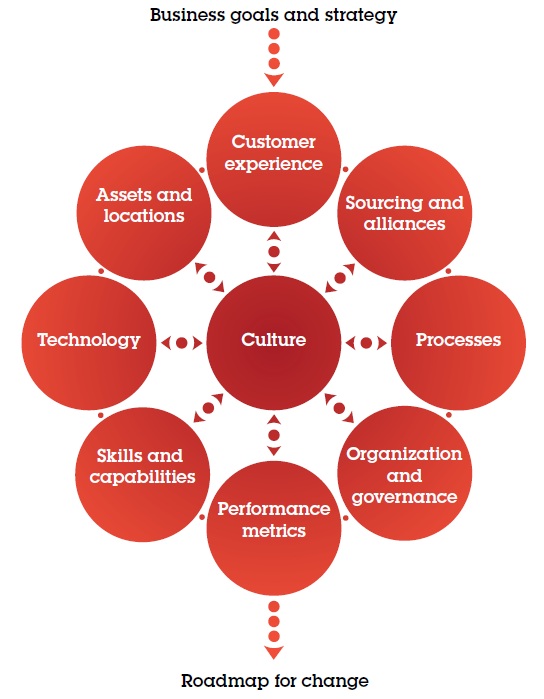
It may be worthwhile visiting some industry definitions for Operating Model before we explore how Enterprise Architecture can be effective here. The definition of Operating Model varies based on the Organisational and Operational context in which it is applied and hence probably one definition may not fit all Operating Model scenarios. However if I had to choose one definition, I would like to refer to the IBM’s definition of the Operating Model (see the picture below)
IBM Target Operating Model (TOM)

IBM proposes that a Target Operating Model (TOM) helps determine the best design and deployment of resources to achieve an organization’s business goals. It provides current operational maturity assessment and roadmap to defining and/or improving organisation’s Operations Strategy. Key deliverable include business review, current operating model assessment, desired future state and change management plan roadmap.
The TOM essentially is seen here as the mechanism to link the business goals and strategy of the organisation with the roadmap for change to achieve those goals. TOM then holds together various organisation concerns such as processes, technology, capabilities, customer view, governance and partners in a single cohesive fashion.
 
Now that we have briefly summarised an illustrative Operating Model definition, let us explore how Enterprise Architecture as a discipline or practice can be leveraged as a tool for its management. There are a number of good Enterprise Architecture Frameworks available for this purpose and recent revisions of certain frameworks have further established them as leading candidates for this purpose. I do not advocate or support a specific Enterprise Architecture Framework on this blog however for illustration purposes I am going to be using the TOGAF 9 as the tool for Operating Model Management. I would like to also mention the Zachman EA framework as the other leading framework which may be equally effective or in some application scenarios it may be a better fit. 
The purpose of this article is not to explain or define the TOGAF 9 and I would highly recommend visiting the OpenGroup website for relevant documentation. However for the ease of reference, I am going to share the TOGAF ADM which is the process for Enterprise Architecture Management in TOGAF. 
The process links the Vision and Strategy of the Organisation and its business / functions with a portfolio of change programs which realises this Strategy. TOGAF uses various architecture disciplines such as Business Architecture, Information Architecture (Data and Application) and Technology Architecture as mechanism for linking the Strategy with Implementation and Governance of Change programs to deliver on the Strategy. 
The central argument which I am now going to make is that such a process of Enterprise Architecture can be seamlessly deployed and leveraged to manage the Organisation Operating Model. A number of Enterprise Architecture Frameworks and especially Zachman categorically state that the application of Enterprise Architecture should not be restricted or limited to the Information Technology systems. It is a true framework for organisation and business management. For instance applying the TOGAF to manage the IBM TOM will result in following steps / mapping. The key here is to use tools, processes, approach, templates and constructs from each of the TOGAF ADM stage to define and develop the TOM stages as seen in figure – 1. 
  1. The business goals and strategy can be defined by the Preliminary phase while the vision underpinning this is defined in Phase A. Architecture Vision
  2. The Assets and the Locations of the TOM along with key processes can be captured and defined during the Phase B. Business Architecture
  3. Certain aspects of skills, capabilities, culture and processes too can be captured in Phase B
  4. The Technology, Processes, Performance Metrics can be captured through phases C and D while defining the Information and the Technology Architecture.
  5. The sourcing options and alliances can be identified and shortlisted in phase E. Opportunities and Solutions
  6. The phase F of migration planning can be used to identify the roadmap for change through what TOGAF calls as transition architectures
  7. Finally culture which is central to TOM needs to be constantly be a driving force as well as the recipient for the requirements for change
I would like to again highlight that this is simply an illustration of managing a view of Operating Model with a particular EA approach. However a number of other variations can be equally effectively managed by similar approach. It will probably make sense to present an illustration and mapping using other EA framework such as Zachman…may be a topic for next post on this blog!

References:

Strategy and transformation for a complex world, IBM Global Services, Mar 2011

The TOGAF Architecture Development Method (ADM)

The Zachman Framework