Link: https://eawheel.com/blog/2026/09/why-architecture-frameworks-matter/
From EAWheel
If there is one statement that has become increasingly common on social media platforms, conference stages, and architecture forums, it is this:
We don’t need architecture frameworks anymore.
Some argue that frameworks are outdated. Others describe them as bureaucratic, heavyweight, or simply incompatible with agile ways of working. According to some, frameworks like the TOGAF® Standard only exist to generate documentation rather than value.
In this blog, I will dive into why architecture frameworks matter.
The loudest voice in the room
The opinions about frameworks are often expressed with great confidence. The interesting part is that they’re rarely backed by experience. In many cases, the criticism doesn’t come from people who have spent years applying an architecture framework successfully. Instead, it originates from those who speak the loudest in the metaphorical room. These are individuals who have faced a flawed implementation, taken on a complicated process, or merely echoed the opinions of others. Somewhere along the way, the framework itself became the scapegoat.
That’s unfortunate. Because an architecture framework isn’t the architecture. It isn’t the architect. And it certainly isn’t the reason projects succeed or fail. A framework is nothing more — and nothing less — than a collection of proven practices that helps architects perform their work more consistently. Notice the emphasis on helps.
Reinventing the wheel
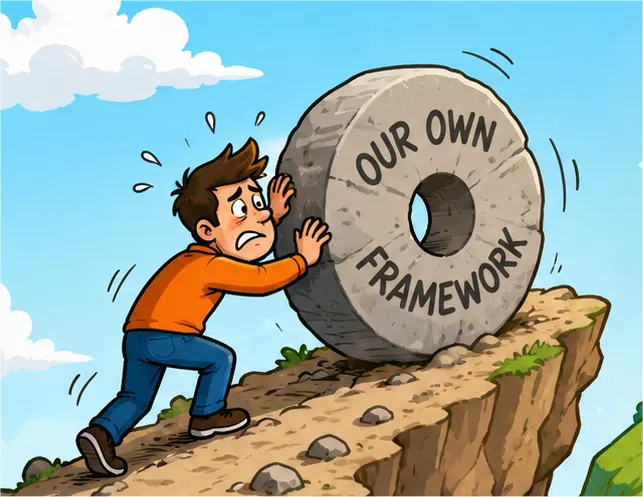
Frameworks don’t replace thinking. They don’t remove the need for experience. They don’t magically solve organizational problems. But they do provide guidance that prevents architects from solving the same problems over and over again. Ironically, organizations that proudly claim they don’t use architecture frameworks often end up building one themselves.
It starts innocently enough. Someone creates a template for architecture decisions. Another person defines review meetings. Governance processes appear, and even architecture principles are documented. Next, standards emerge and reference architectures begin circulating. Responsibilities are clarified.
After a few years, the organization has quietly created its own architecture framework.
They simply chose to reinvent it instead of adopting and tailoring one that already existed. That raises an interesting question. If every mature architecture practice eventually develops a framework, why not begin with one that already incorporates decades of experience?
Using what’s already there
Imagine being asked to build a bridge. Would you ignore everything engineers have learned over the last hundred years? Would you reject established construction methods because they’re old? Of course not. You would study proven approaches first. You would learn what works, and you would understand what has failed before. Only then would you adapt those practices to the specific bridge you’re building.
Architecture isn’t any different.
Thousands of architects have faced similar challenges before us. Frameworks such as the TOGAF Standard capture much of that collective experience. They don’t claim to contain every answer, but they provide a structured starting point that has evolved through decades of practical application across industries. That’s incredibly valuable. Without such guidance, every organization starts from scratch.
Using a framework doesn’t mean surrendering creativity. Quite the opposite. The framework handles many of the recurring questions so architects can spend more time solving the problems that truly differentiate their organization. That distinction is important. Competitive advantage rarely comes from inventing architecture governance. It comes from using architecture effectively.
Tailoring is where the value begins
One of the biggest misunderstandings surrounding architecture frameworks is the belief that they must be implemented exactly as written.
Nothing could be further from the truth.

Every organization is different. A multinational bank doesn’t require the same architecture practice as a regional healthcare provider. A start-up shouldn’t have the same governance as a government agency. An agile software company won’t work the same way as a manufacturing organization. This is precisely why tailoring is fundamental.
Frameworks are designed to be adapted. Some guidance will be highly relevant, and some will require adjustment. Some may not be needed at all. That’s not a weakness. It’s one of their greatest strengths.
Unfortunately, many failed framework implementations ignored this principle. Rather than asking “What does our organization actually need?” they asked “How do we implement every part of the framework?” The result wasn’t architecture. It was bureaucracy. The framework wasn’t the problem. The implementation was.
Preventing blind spots
Architecture is, by its very nature, complex. Even relatively small transformation initiatives involve business processes, applications, data, technology, security, compliance, governance, stakeholders, budgets, risks, dependencies, and implementation considerations.
No architect — regardless of experience — can keep every relevant aspect in mind all the time. We’re human. We’re influenced by deadlines. We focus on immediate problems and become distracted by urgent requests. And sometimes we simply forget to ask an important question. That’s where an architecture framework quietly proves its worth. Not because it tells you what to think. But because it reminds you what to consider.
Think about the number of architecture initiatives that struggle because something wasn’t necessarily done incorrectly — it simply wasn’t done at all. Perhaps key stakeholders weren’t involved until the solution had already been designed. Maybe implementation governance was never established. Perhaps dependencies between projects were discovered too late. Or the target architecture looked impressive on paper but ignored organizational readiness.
These aren’t unusual mistakes. They’re remarkably common. The most expensive mistakes rarely result from forgetting something complicated. They result from overlooking something fundamental.
Asking better questions
Experienced architects often develop the habit of asking the right questions naturally over time. They know which questions to ask because they’ve learned from previous successes — and previous failures. Frameworks accelerate that learning process. Instead of relying entirely on personal experience, they provide a checklist of considerations that has already been refined through years of practical application.
Notice that I didn’t say a checklist of deliverables. There’s an important distinction. Frameworks shouldn’t encourage architects to produce documents for the sake of documentation. They should encourage architects to ask better questions. Good architecture isn’t measured by the number of artifacts produced. It’s measured by the quality of the decisions those artifacts support.
Governance is not bureaucracy
Few words in Enterprise Architecture have developed a worse reputation than governance. Mention governance and many people immediately picture approval boards, lengthy meetings, endless forms, and frustrating delays. Unfortunately, some organizations have reinforced exactly that perception.
Governance became synonymous with bureaucracy. Architecture reviews became obstacles instead of enablers. Decision-making slowed to a crawl.
It’s easy to understand why people became skeptical. But once again, this isn’t a failure of the framework. It’s a failure of implementation. At its core, governance is remarkably simple. It answers a few basic questions.
- Who is allowed to make which decisions?
- How are those decisions evaluated?
- How do we ensure they remain aligned with organizational objectives?
- How do we learn from previous decisions?
That’s all governance really is. It’s not about saying “no“. It’s about helping organizations say “yes” with confidence. Without governance, architectural decisions tend to become inconsistent. Good governance ensures that important architectural knowledge doesn’t disappear along with them.
Frameworks don’t replace architects
One criticism occasionally directed at architecture frameworks is that they somehow restrict innovation. I would argue the opposite. Frameworks remove unnecessary uncertainty. They establish a stable foundation from which architects can innovate more effectively.
Think about other professions.
- Doctors follow medical guidelines.
- Pilots use checklists.
- Civil engineers rely on established engineering principles.
- Software developers use design patterns.
None of these professionals consider guidance to be a limitation. They consider it a starting point. Architecture should be no different. The framework doesn’t design your architecture. You do. The framework doesn’t solve organizational problems. You do. The framework doesn’t replace experience. It helps experience become more effective.
This distinction matters because successful architecture has never been about following a methodology. It has always been about applying judgment. Frameworks simply provide structure that allows good judgment to be exercised more consistently.
Final thoughts
Enterprise Architecture has always been about creating clarity in environments filled with complexity. Architecture frameworks support that objective in three important ways. They allow us to benefit from proven practices rather than reinventing them. Frameworks reduce blind spots by encouraging architects to ask the right questions. And they provide governance that enables better, more transparent decision-making.
None of these advantages require blind adherence to a framework. In fact, quite the opposite. The most successful architects I’ve worked with all have these things in common:
- They tailor.
- They simplify.
- They adapt.
They understand that the framework exists to serve the organization — not the other way around.
Perhaps that’s the message we should be communicating more often. Architecture frameworks are not the destination. They’re the map. A good map doesn’t tell you where you must go. It simply helps you reach your destination with fewer wrong turns. And that’s something every architect can appreciate.
The post Why Architecture Frameworks Matter appeared first on EAWheel.
