Four principles for a sane society

How do we make sense of the big-picture in enterprise-architecture? The really big-picture? Yep, it’s that time of year again: the lead-up to the annual Integrated EA conference, where they allow me to go somewhat off-the-wall and present the current ‘big-idea’

Family

Another Christmas, another cold. I just don’t seem well adapted for English winter… Nor for families either, I guess. In England at least, Christmas is both a religious festival and family festival – yet even at best I’ve never felt

On the Cultural-Linguistic Turn

A number of bloggers have talked about the central importance of story-telling
and sense-making in the architect’s craft. So I wanted to highlight an
interesting piece about Rowan Williams in the Guardian recently, with
possible relevance to the pra…

Categories Uncategorized Tags

On Agility, Culture and Intelligence

Deal and Kennedy (1982) proposed a model of organizational culture, which depended on two factors, risk and the speed of feedback.
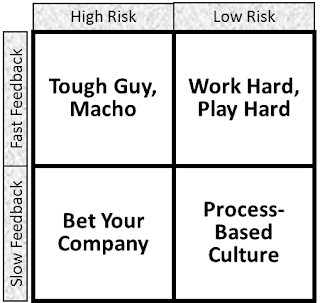
Source: Deal and Kennedy

Meanwhile, speed of feedback also affects organizational intelligence. Shorter feedback loops are associated with greater agility and responsiveness, and faster learning, and is a popular meme of the Agile Software movement. Shahzad Bhatti is one of those who emphasizes the link with John Boyd’s OODA loop.

“One of key finding he made was that shorter feedback or iteration loop of OODA with low quality was better than longer or tiring cycle of OODA with high quality. Despite the fact that everyone calls his/her organization agile, this feedback loop is real essense of agility.”

So that seems to associate Agile with the upper two quadrants of the Deal and Kennedy model, and OODA with the top left quadrant.

So then what are the cultural implications of Agile for the host organization?


Notes and references

Lisa Crispin, Shortening the Feedback Loop (March 2011)
Ilan Kirschenbaum, What does a butterfly say at the end of the day? (May 2012)
Rune Larsen, Know your feedback loop – why and how to optimize it (Oct 2012)
Thomas Sundberg, Why should you use different technical practises when you develop software? (April 2011)


Places are still available on my Organizational Intelligence workshop, November 22nd.

An architecture of enterprise-culture

[A collection of notes that I made somewhen around May 2010 that I don’t seem to have published before, and seem to be relevant now as I explore my own business-model. (Not an April-Fool joke, by the way. ) ] A culture [enterprise-culture] is a set of prioritised values and goals – usually ill-expressed, conflicting, a muddled-mixtures […]

Competence, non-competence and incompetence

One of the key reasons why I’m so vehemently against any-centrism and suchlike revolves around the question of competence – or, more usually, the lack of it. Competence is where someone knows what they’re doing, and does it. And, oddly, often don’t bother to say that they’re competent – perhaps because they don’t need to […]

More on identity and Mask

Who or what is ‘I’? How does our experience of ‘I’ change as we interact with our world? Yes, I do know that those questions might seem to fit more in philosophy or psychology. But as per the previous post, they also have huge ramifications in user-experience and user-interface design, in product-design, in sensemaking and […]

Identifier, identity, persona and Mask

Who or what is ‘I’? How do others recognise that ‘I’? How does that ‘I’ express itself? – with what voice does that ‘I’ speak? And how do others recognise that voice? Yeah, I know, sounds like philosophy and stuff – woefully abstract, deep and pointless. Yawn. But those ‘pointless’ questions are the core – the […]

Cycles within cycles

It’s customary at this time of year to do some kind of review: what’s happened in the past annual cycle, hopes and intentions for the next. [Sometimes these reviews can be a bit too predictable in their over-focus on prediction? As Forrester enterprise-architect Brian Hopkins put it in a nicely ironic Tweet this morning, “I predict […]

Happy Whatever!

‘Tis the season for… something, probably? For many people, it’s ‘the ‘Holiday Season’, or Christmas, or New Year, or something like that. A calendrical marker-point, anyway. Something to celebrate, perhaps. The culture I come from is nominally Christian, hence ‘Christmas’ and suchlike, so that’s the label others around me tend to use. (Though it doesn’t […]

Competition-against or competition-with?

What’s the point of competition, in a business-context? Perhaps more to the point, what is competition in a business-context? And why? Another of those ‘obvious’ question-themes that turn out to be not so obvious at all… And the answers are very important in enterprise-architecture, business-architecture and business-model design: not least because if we get it […]

When identical is not the same as equal

Is ‘identical’ always the same as ‘equal’? Not in service-design – and one of the issues we need to watch for is to ensure that identical service-provision does not lead to far-from-equal service-outcomes. If ever you want an all-too-real example of this problem in practice, go to almost any public event, and note the huge queues […]