Link: https://eawheel.com/blog/2026/10/organizational-sustainability/
From EAWheel
When we talk about sustainability, most of us probably think about environmental sustainability. Reducing carbon emissions, using fewer resources, moving towards a circular economy, and so on. But there is another form of sustainability that deserves more attention: the organizational sustainability.
Can an organization continue to create value when the world around it changes? Can it adapt when customer expectations shift, regulations change, competitors emerge from unexpected places, technologies evolve, or economic and geopolitical circumstances suddenly turn against it? In other words, can the organization remain viable when its environment refuses to stand still?
I believe Enterprise Architecture has an important role to play in answering that question.
Defining sustainability
There is a potential misunderstanding when we talk about sustainability. We sometimes associate sustainability with stability. Something sustainable is something that can continue indefinitely. But that doesn’t mean that it doesn’t change.
Consider a living organism. It remains viable precisely because it continuously adapts to its environment. Organizations are much the same. An organization that refuses to change is not sustainable. Eventually, the environment around it will change so much that the organization becomes irrelevant.
So perhaps a better definition of organizational sustainability is:
The ability of an organization to continuously adapt and create value without undermining its long-term viability.
And that immediately creates an interesting architectural challenge. We need stability and flexibility at the same time. We need enough stability to prevent the organization from descending into chaos. But we also need enough flexibility to respond to change. This is where good Enterprise Architecture comes in. Good architecture doesn’t eliminate change. It makes change more manageable.
Designing for change
Imagine designing a building. If changing one room requires demolishing half the building, you probably wouldn’t consider that a particularly good design. The building may look beautiful, and the architectural drawings may be flawless. The documentation may even be impeccable. But the design doesn’t accommodate change very well.
Now imagine the same thing happening inside an organization. Introducing a new product requires changes to ten applications. Changing one business process requires modifications to multiple integrations. A new regulation requires months of analysis simply to determine what is affected. Acquiring another company creates an enormous integration problem because nobody understands how the two organizations fit together.
At some point, we have to ask ourselves: is the organization struggling with change, or did we design it badly for change?
That’s an architectural question. And this is where the Enterprise Architecture Implementation Wheel (EA Wheel) becomes particularly relevant.
A cycle for sustainable change
The Enterprise Architecture Implementation Wheel is based on the TOGAF® Standard. The method adapts TOGAF’s structure and flow by reorganizing it into four main stages: Document, Define, Execute, and Control. Each stage is broken down into one or more steps, each of which includes key focus areas and actionable artifacts.
Rather than aiming for exhaustive coverage, the EA Wheel provides a scalable foundation that organizations can build upon as they mature. It establishes a solid basis for effectively adopting and applying the core principles of the TOGAF Standard.
At first glance, the stages of the approach may look like four straightforward steps for implementing Enterprise Architecture. But there is something deeper going on. These stages form a continuous cycle. That continuous cycle is precisely what makes the EA Wheel relevant to organizational sustainability.
Let’s look at each stage from that perspective.
Stage one: Document
Creating visibility
Before we can sustainably change an organization, we need to understand it. That sounds obvious, but it is surprisingly difficult.
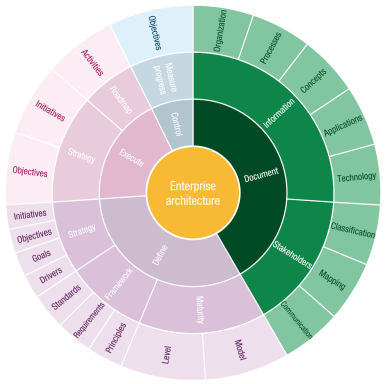
- What capabilities or business functions does the organization actually have?
- Which processes support them?
- Where does important information reside?
- Which applications are involved?
- Which technologies are critical?
- Where are the dependencies, redundancies, and vulnerabilities?
Being able to answer these questions matters because complexity is one of the greatest enemies of sustainable change. Every unnecessary dependency creates another potential point of failure.
- Every duplicated capability creates additional cost.
- Every tightly coupled system makes future change more difficult.
- Every undocumented dependency creates another potential surprise.
Documentation therefore isn’t valuable because organizations need more documentation. It is valuable because visibility enables better decisions. The Document stage doesn’t imply that everything has to be documented; rather, only what is significant to the organization should be.
Without an adequate understanding of the current architecture, we are effectively making decisions in the dark. And sustainable change is difficult when you don’t know what you’re changing.
Stage two: Define
Designing the organization for its future
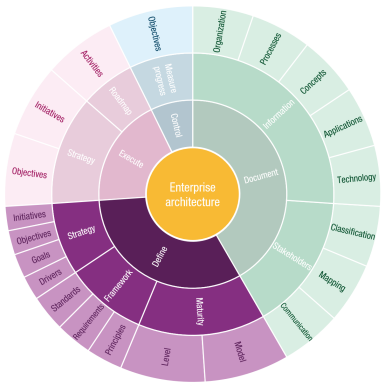
Once we understand where we are, the next stage to pay attention to is Define. This is where architecture moves from describing reality to designing a better future.
- What should the organization look like?
- Which capabilities will it need?
- Which principles should guide decisions?
- Where should we standardize?
- Where should we allow variation?
- Where should we simplify?
- And where do we deliberately preserve flexibility?
This last point is particularly important. Sustainability does not mean standardizing everything. Sometimes standardization creates sustainability, but other times modularity does, or even decentralization. And sometimes the most sustainable architectural decision is to keep options open.
For example, an organization may decide to standardize on a single technology platform because this reduces complexity and cost. That may seem like the right decision. But what happens if that platform becomes obsolete? What if the supplier dramatically changes its pricing, or what if the organization enters a market where the platform cannot support a critical requirement? The architecture may have been optimized for today’s situation while becoming less sustainable for tomorrow.
This is why good architecture isn’t simply about optimization. It is about making conscious choices and understanding their consequences. The Define stage gives us the opportunity to do exactly that. It allows us to define an organization that isn’t merely efficient today, but remains capable of adapting tomorrow.
Stage three: Execute
Turn architectural intent into reality
The third stage of the Enterprise Architecture Implementation Wheel is called Execute. This is where many architecture initiatives struggle. Many architects have the ability to design a remarkable target architecture and pinpoint the gaps between our current state and the future we aim for. Stunning models can be crafted, and who better than us architects to establish practical principles?
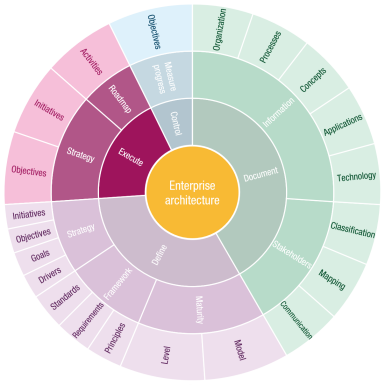
But none of that makes the organization more sustainable unless the architecture influences actual change.
Architecture must connect to initiatives, projects, and operational change. It’s important for us to not only grasp the difference between our current architecture and the target one, but we also need to determine the best way to bridge that gap. This doesn’t necessarily mean moving directly from today’s architecture to some perfect future state. In a turbulent environment, that can actually be dangerous.
Instead, we can use transition architectures. We can move from A to B through a series of deliberate, manageable steps. And this illustrates another important principle of sustainable architecture: design the journey, not just the destination. Because in a turbulent environment, the destination itself may change while we’re on our way there.
A five-year transformation plan that assumes the world will remain stable for five years may not be particularly sustainable. A sequence of smaller, coherent changes that allows us to learn and adapt along the way may be much more resilient. Execution therefore isn’t simply about implementing the architecture. It is about turning architectural intent into controlled organizational change.
Stage four: Control
Keep the architecture sustainable
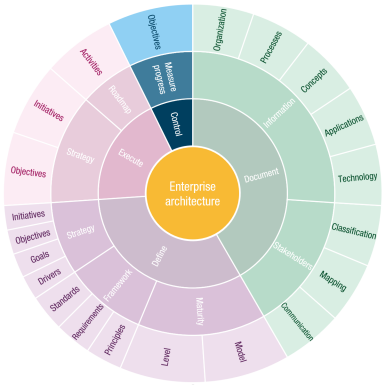
And then we arrive at the fourth stage: Control. This is perhaps the stage that most clearly connects the EA Wheel to sustainability. Because architecture isn’t something we should design once and then put on a shelf. As the world changes, so does the organization. But also, technology changes, and so do customer expectations. And regulations. The architecture therefore needs to be continuously evaluated.
- Are we still moving towards the outcomes we originally intended?
- Are our capabilities developing as expected?
- Are our principles still valid?
- Are our standards still appropriate?
- Is complexity increasing?
And perhaps most importantly: is the architecture still fit for purpose?
This creates the feedback loop that makes the EA Wheel a continuous cycle rather than a one-time exercise. That is important because sustainability isn’t something we achieve once. It is something we maintain.
Together, these create something very valuable: structured flexibility. Enough structure to prevent chaos, and enough flexibility to respond to change.
The ability to change
So perhaps we should rethink what we mean when we say that Enterprise Architecture “supports the business”. That phrase can be interpreted rather passively. As if architecture exists to document the business and make sure IT is aligned with it.
I think we can aim higher.
Enterprise Architecture can help design the organization’s ability to change. And the EA Wheel provides a practical way of doing that. By documenting the enterprise so that we understand it, and by defining the architecture so that we know where we want to go. By executing change so that architecture becomes reality, and controling the results so that the architecture remains fit for purpose.
The objective isn’t to arrive at some final architecture. There probably isn’t one. The objective is to establish an organizational capability that can continuously sense, decide, change and adapt.
That is what makes the organization sustainable.
The post Organizational Sustainability appeared first on EAWheel.
