What’s Innovation Worth?

What does an old World War II tank have to do with innovation? I’ve mentioned it before, but it bears repeating – one of benefits of having a blog is the ability to interact with and learn from people all over the world. For example, Greger Wikstrand and I have been trading blog posts on […]

Towards a whole-enterprise architecture standard – 5: Practices and toolsets

For a viable enterprise ­architecture [EA], now and into the future, we need frameworks, methods and tools that can support the EA discipline’s needs. This is Part 5 of a six-part series on proposals towards an enterprise-architecture framework and standard for whole-of-enterprise architecture: Introduction

Beyond Bimodal

Ten years ago (March 2006) I attended the SPARK workshop in Las Vegas, hosted by Microsoft. One of the issues we debated extensively was the apparent dichotomy between highly innovative, agile IT on the one hand, and robust industrial-strength IT on the other hand. This dichotomy is often referred to as bimodal IT.

In those days, much of the debate was focused on technologies that supposedly supported one or other mode. For example SOA and SOAP (associated with the industrial-strength end) versus Web 2.0 and REST (associated with the agile end).

But the interesting question was how to bring the two modes back together. Here’s one of the diagrams I drew at the workshop.

Business Stack

As the diagram shows, the dichotomy involves a number of different dimensions which sometimes (but not always) coincide.

  • Scale
  • Innovation versus Core Process
  • Different rates of change (shearing layers or pace layering)
  • Top-down ontology versus bottom up ontology (“folksonomy”)
  • Systems of engagement versus systems of record
  • Demand-side (customer-facing) versus supply side
  • Different levels of trust and security

Even in 2006, the idea that only industrial-strength IT can handle high volumes at high performance was already being seriously challenged. There were some guys from MySpace at the workshop, handling volumes which were pretty impressive at that time. As @Carnage4Life put it, My website is bigger than your enterprise.

Bimodal IT is now back in fashion, thanks to heavy promotion from Gartner. But as many people are pointing out, the flaws in bimodalism have been known for a long time.

One possible solution to the dichotomy of bimodalism is an intermediate mode, resulting in trimodal IT. Simon Wardley has characterized the three modes using the metaphor of Pioneers, Settlers, and Town Planners. A similar metaphor (Commandos, Infantry and Police) surfaced in the work of Robert X Cringely sometime in the 1990s. Simon reckons it was 1993.

Asked “Isn’t bimodal new?” … god no. It’s a bad rehash of ideas from a decade or more ago. Even “tri” modal dates back to 1993.

— swardley (@swardley) April 27, 2016

Trimodal doesn’t necessarily mean three-speed. Some people might interpret the town planners as representing ‘slow,’ traditional IT. But as Jason Bloomberg argues, Simon’s model should be interpreted in a different way, with town planners associated with commodity, utility services. In other words, the town planners create a robust and agile platform on which the pioneers and settlers can build even more quickly. This is consistent with my 2013 piece on hacking and platforms. Simon argues that all three (Pioneers, Settlers, and Town Planners) must be brilliant.

absolutely @mjbrender @richardveryard @TheEbizWizard : all three must be brilliant … https://t.co/DHMtkmrgzs

— swardley (@swardley) May 4, 2016

Characterizing a mode as “slow” or “fast” may be misleading, because (despite Rob England’s contrarian arguments) people usually assume that “fast” is good and “slow” is bad. However, it is worth recognizing that each mode has a different characteristic tempo, and differences in tempo raise some important structural and economic issues. See my post on Enterprise Tempo (Oct 2010).

Updated – corrected and expanded the description of Simon’s model.  Apologies for Simon for any misunderstanding on my part in the original version of this post.


Jason Bloomberg, Bimodal IT: Gartner’s Recipe For Disaster (Forbes, 26 Sept 2015)

Jason Bloomberg, Trimodal IT Doesn’t Fix Bimodal IT – Instead, Let’s Fix Slow (Cortex Newsletter, 19 Jan 2016)

Jason Bloomberg, Bimodal Backlash Brewing (Forbes, 26 June 2016)

Rob England, Slow IT (28 February 2013)

Bernard Golden, What Gartner’s Bimodal IT Model Means to Enterprise CIOs (CIO Magazine, 27 January 2015)

John Hagel, SOA Versus Web 2.0? (Edge Perspectives, 25 April 2006)

Dion Hinchcliffe, How IT leaders are grappling with tech change: Bi-modal and beyond (ZDNet, 14 January 2015)

Dion Hinchcliffe, IT leaders inundated with bimodal IT meme (ZDNet, 1 May 2016)

Dare Obasanjo, My website is bigger than your enterprise (March 2006)

Richard Veryard, Notes from the SPARK workshop (March 2006), Enterprise Tempo (October 2010), A Twin-Track Approach to Government IT (March 2011),

Richard Veryard, Why hacking and platforms are the future of NHS IT (The Register, 16 April 2013)

Richard Veryard and Philip Boxer, Metropolis and SOA Governance (Microsoft Architecture Journal, July 2005)

Simon Wardley, Bimodal IT – the new old hotness (13 November 2014)

Simon Wardley, On Pioneers, Settlers, Town Planners and Theft (13 March 2015)

Lawrence Wilkes and Richard Veryard, Extending SOA with Web 2.0 (CBDI Forum for IBM, 2007)

updated 27 June 2016

Insight Platforms Have Arrived

Are you lost in a confusing soup of vendor-speak about what their data analytics stack actually offers? Big data, data platforms, advanced analytics, data lakes, real-time everything, streaming, the IoT, customer analytics, digital intelligence, real-t…

Towards a whole-enterprise architecture standard – 4: Content

For a viable enterprise ­architecture [EA], now and into the future, we need frameworks, methods and tools that can support the EA discipline’s needs. This is Part 4 of a six-part series on proposals towards an enterprise-architecture framework and standard for whole-of-enterprise architecture: Introduction

Towards a whole-enterprise architecture standard – 3: Method

For a viable enterprise ­architecture [EA], now and into the future, we need frameworks, methods and tools that can support the EA discipline’s needs. This is Part 3 of a six-part series on proposals towards an enterprise-architecture framework and standard for whole-of-enterprise architecture: Introduction

The Flag Application Architecture torment

On computer architecture flags have always played a substantial role, as well in certain application development. Since most data and business architecture was done on a batch principle mainly driven by the limitation in technology, flag also got used in a lot of solution architecture. The problem in all areas is that despite of new … Continue reading The Flag Application Architecture torment

Towards a whole-enterprise architecture standard – 2: Core

For a viable enterprise ­architecture [EA], now and into the future, we need frameworks, methods and tools that can support the EA discipline’s needs. This is Part 2 of a six-part series on proposals towards an enterprise-architecture framework and standard for whole-of-enterprise architecture:

Birthing an Industry Standard for Higher Education

Have you ever wondered how industry standard reference models come to be? At Enterprise Architects and FromHereOn we embrace and promote the use of reference models in jump starting the strategy and architecture efforts of […]

The post Birthing an Industry Standard for Higher Education appeared first on Enterprise Architects.

Scaled Agile Factory – Going Beyond the Usual Suspects

Abstract: If you address the question of how to scale Agile projects by considering what framework to use, you are only looking at one aspect of the problem. Scaling is all about coordination – managing enterprise considerations and cross program dependencies, and the defacto frameworks (SAFe, LeSS and DAD) focus on the people and process dimensions. However, in combination with a factory approach you may be able to automate many of the compliance and dependency management issues.

The question of how to scale Agile development has been around a while. In January 2015 I commented [1] on a clear trend in which my customers were voicing concerns about loss of consistency; inability to govern; lack of coordination and increasing time to market. Since then I have observed many large organizations adopting SAFe (Scaled Agile Framework) perhaps because it appears to be the only game in town, or perhaps there’s good marketing or there’s strength in numbers. But the criticisms of SAFe [2] haven’t gone away. The central and continuing concern is that SAFe compromises core Agile principles of self-organizing, cross functional teams that have full responsibility for the delivery of potentially shippable increments. And that SAFe looks suspiciously like WaterScrumFall because there’s a high overhead of portfolio, value stream and project management and in all probability intentional architecture. Now I have mixed opinions on SAFe; I see positives in value streams and product management which are important. And for organizations that have large programs, highly organized, structured approaches will be seen as lower risk, and indeed something that takes them some way down the Agile path, without straying too far from conventional management comfort zones. But the outcomes are unlikely to be inherently “agile”.

What SAFe does, is provide a rather conventional approach for a complex problem that most enterprises have – that is to deliver high integrity solutions that can work in an enterprise context that demands cross project dependency management, consistent data and reference architecture, collaboration with the existing portfolio complexities, compliance with enterprise standards and governance etc.

There are alternatives. Craig Larman and Bas Vodde in their books [3] and more recently with their LeSS initiative [4] have pursued a very different path that starts with Scrum and scales by understanding the needs for coordination while adhering to core Scrum principles. In their forthcoming book [5] they say, “LeSS is (1) lightweight, (2) simple to understand, and (3) difficult to master—due to essential complexity”. And this allows us to contrast the different approaches; while SAFe clearly works at some level, it has its roots in conventional large scale project management, whereas LeSS is lightweight, but requires much deeper understanding of the systems dynamics because of the inherent complexity of all the coordination requirements.
So the real question underlying Scaling Agile should be, “can we address some of the coordination requirements in a manner that reduces complexity and eliminates some of the need for additional layers of management or events?”

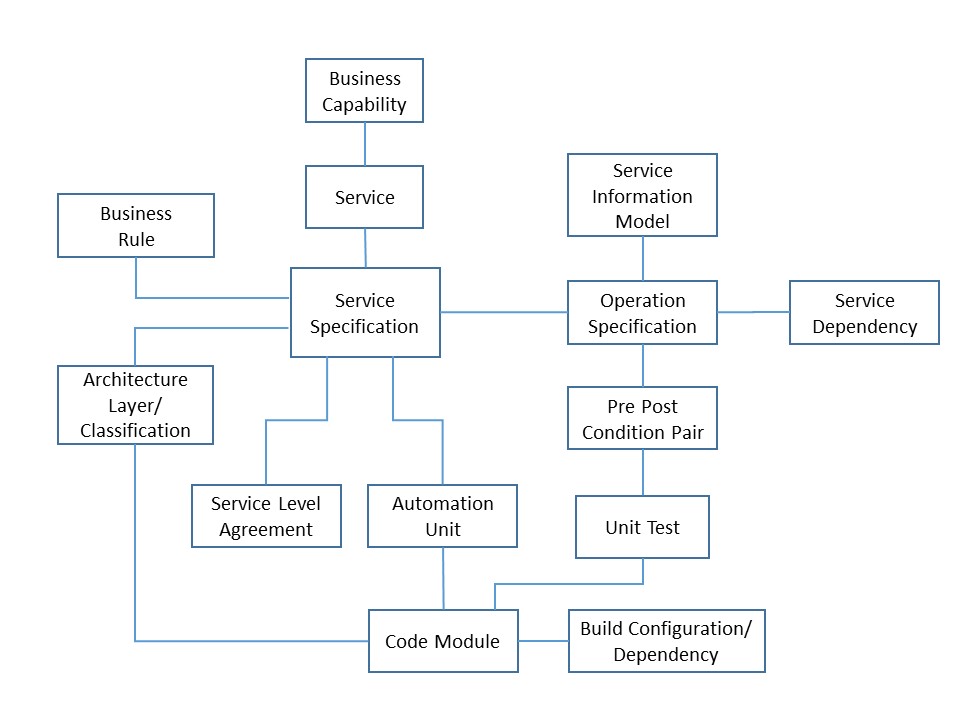
In my post Service Factory 2.0 [6] I describe the conceptual background of the Software Factory, ideas pioneered by my old friend Keith Short and Jack Greenfield while they were at Microsoft. Today these have evolved and become specialized around a framework of tools, repeatable processes and patterns for creation and assembly of services – manifest as first order components with formal interfaces. If you consider that all core business functionality is increasingly composed of services and their operations, this provides us with a reference architecture that by design implements separation of concerns.  Figure 1 below is a conceptual view of the scope of the service factory in terms of managed objects.

Figure 1
Naturally there will be other patterns involved in any solution including UX and workflow; but for most enterprise class solutions, a high proportion of the functionality should comprise services and business rules. This allows a consistent, highly automated approach to architecture, requirements specification, design and test. The factory effectively implements a proven service reference architecture as a platform which can be customized for individual programs, projects and technologies. While the factory platform is similar to an architecture runway in scope and intent, because it is model based the factory framework enables continuous evolution of the platform capabilities that are automatically inherited into work in progress factory code allowing program wide changes to be incorporated, often with minimal or no change to the service specific code. And the factory is a repository of the life cycle artifacts that can be leveraged for various management tasks including governance of traceability, impact analysis, etc. 
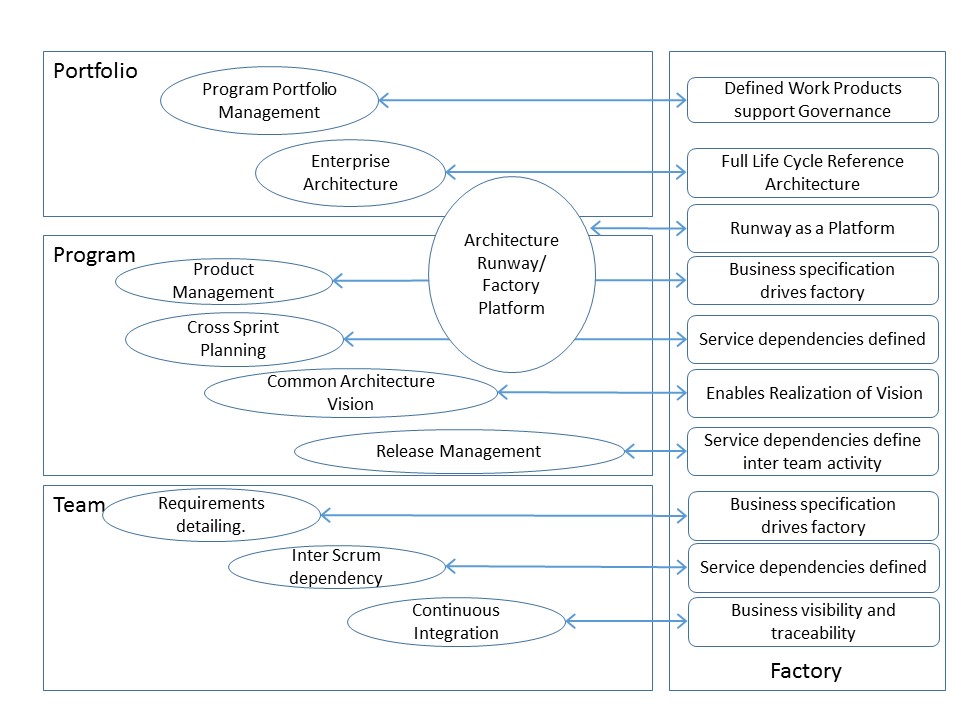
Let’s consider the key coordination and management activities typically required in a scaled agile program and how the factory may facilitate that. In Figure 2 below I have used the SAFe layers of portfolio, program and team, albeit without the value stream level. But apart from that, the view is intended to be framework neutral. The diagram illustrates how the Factory provides a full life cycle backplane that establishes the underlying (meta) model that ensures all the participants are in compliance with core concepts from portfolio planning through to delivery and production. The populated model is therefore able to provide essential information particularly about dependencies, but equally complete traceability and governance between business requirements and delivered services and rules.  
Figure 2
In the LeSS framework, Larman and Vodde disregard constructs such as ART (Agile Release Train) and 8 to 12 week PIs (Program Increments) and also the Hardening Sprint, preferring to use the standard Scrum duration of 2 to 4 weeks, with continuous integration.  We might assume these management constructs (ARTs and PIs) were invented because of the difficulty of effective inter team communications, and the overhead that creates. Larman and Vodde have a lot of good ideas about how to manage effective inter Teams communications, but their approach is essentially based on feature or story dependencies. In the factory environment inter-team dependencies can be more accurately based on service operation dependencies. But this is just the tip of the iceberg, in terms of how the factory can be leveraged to manage activity. The service specification becomes a pivotal work product; as it becomes available other teams and team members have access to detailed behaviour information that can inform and facilitate working ahead for developing depending services, test case development including automation assistance in case development, plus devops. 
Another huge issue in Agile projects is managing technical debt. In the factory environment the standard patterns generate all the infrastructure and shared code, and when changes take place, as discussed above, teams can perform an architecture update, inheriting all the changes to bring their project in line with the latest reference architecture. And because the factory is driven by the specification level, independent of technology it is inherently late binding, allowing change if technology with minimum impact.  
By utilizing work products that are part of a defined process based on the full life cycle reference architecture, the factory approach reduces the essential complexity of the scaling task. All moving parts are under management. This doesn’t detract from the inherent purity of the Agile approach. Rather, the defined process provides clarity over the minimum necessary “planning work” (intentional architecture, rules definition and business requirements). And the reference architecture and factory process provide a firm foundation on which emergent architecture can be more effectively carried out by the cross functional delivery team. This is likely to encourage programs to adopt a hybrid approach to their organizing model, embracing elements of LeSS like guidance to optimize multiple concurrent Scrum based sprints with continuous delivery, and to complement them with minimum necessary elements of SAFe, particularly those that are required to communicate to more conventional stakeholders. But, at least for mid-sized projects, maybe up to 10 teams, it seems overkill to adopt the formality of PI Planning and everything that comes with it.
In this post I have focused on the scaled Agile approach for projects, but it’s also useful to understand the factory has other important outcomes. First the highly modular nature of the reference architecture (see Figure 1) leads to “solutions” that are inherently agile. Because solutions are comprised primarily of services and rules with strong formal contracts, implemented using component based implementation patterns, the horizon of change is likely to be very constrained. Further the specification approach in which services, rules, data and processes are defined independent of implementation and technology provides high levels of visibility to the business, and high transparency and traceability of the implemented solution. Finally, we have a way to realize architecture in inherently agile solutions without Big Upfront Design, or indeed Big Upfront Organization, that will of course never become legacy because they can be continuously evolved. 
[2] Reasoned criticisms of SAFe
[3] Scaling Lean & Agile, Craig Larman and Bas Vodde, Addison Wesley, 2009